


 Back to blog
Egocentric Data: How First-Person AI Data Works

 CEO of Label Your Data


Table of Contents

TL;DR
- First-person video data differs technically from standard computer vision data due to constant camera motion, dominant hand-object interactions, and strong temporal dependencies.
- Spatial AI and robotics teams use egocentric data to build real-time perception for wearables, AR interfaces, and humanoid control systems.
- Public research datasets like Ego4D provide broad baseline coverage, while custom datasets allow you to target specific hardware optics and product edge cases.
- Effective egocentric data annotation requires labeling fine-grained object masks, hand-interaction schemas, and multi-step temporal action boundaries, a workload most in-house teams can’t absorb without expert annotation support.
With a fixed wall camera recording an assembly worker, you get a steady view of the person, their workspace, and every tool on the bench. A head-mounted rig provides a different picture instead: hands dart in and out of view, handheld tools block target parts, and simple head turns shift the entire angle instantly. That’s egocentric data.
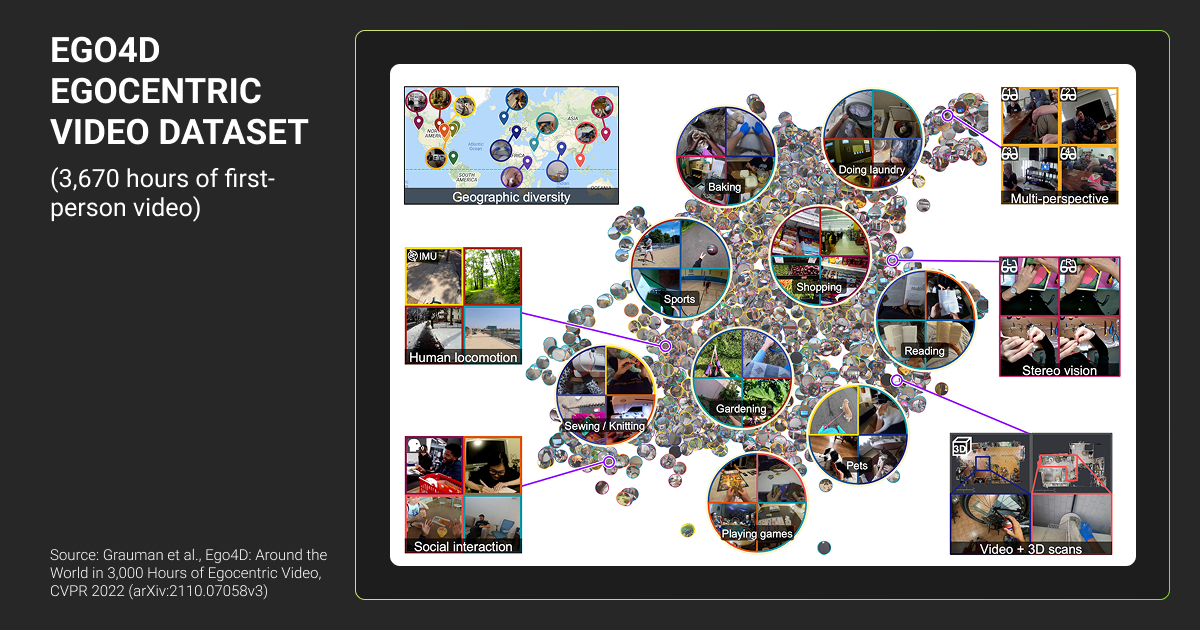
First-person footage is a distinct training data category required for developing AR glasses, wearable tech, or mobile robots where the angle matters. Projects like Ego4D show what that looks like in practice, packing 3,670 hours of video across 74 global locations.
In this article, we explain what egocentric data is, where to source it, and how it changes egocentric annotation workflows for the perception pipeline of any complexity.
What Is Egocentric Data?
Egocentric data is visual, audio, or sensor information captured from the first-person perspective of the human or agent who interacts with a real-world environment. This data comes from smart glasses, head-mounted rigs, wearable tech, or sensors built directly onto a robot.
Third-person (or exocentric) data, on the other hand, relies on an external camera watching everything unfold from a distance.
Egocentric data is also rarely just plain RGB video. Unlike typical machine learning datasets, these often package video alongside synchronized audio, gaze tracking, spatial depth, and IMU sensor streams to give a complete picture of what’s happening in the real-world scenario.
| Egocentric (first-person) data | Exocentric (third-person) data |
| Camera moves with actor | Camera observes actor externally |
| Hands/tools often dominate the view | Full actor/environment often visible |
| Camera and body motion are closely linked | Camera motion may be independent |
| Shows interactions from the actor’s perspective | Shows interactions from an observer’s perspective |
How Egocentric Data Differs from Standard CV
First-person video presents technical conditions that standard computer vision datasets never replicate. Here are three key areas egocentric data is different from that used in standard image recognition or any other ML project.
Continuous camera viewpoint changes
Natural head and body movements produce direct camera motion. Rapid viewpoint shifts, motion blur, and sudden changes in object scale occur constantly across frames. Target items enter and leave the field of view frequently.
This increases partial occlusion and complicates persistent tracking. In egocentric vision, camera movement forms a direct component of the recorded activity.
Dominant hand-object interaction signals
Egocentric video data places human hands, tools, and manipulated items directly at the frame center. First-person AI technologies process functional relationships rather than simple object presence.
As a result, annotation shifts from labeling static objects to tracking a structural sequence of hand, object, and state change:
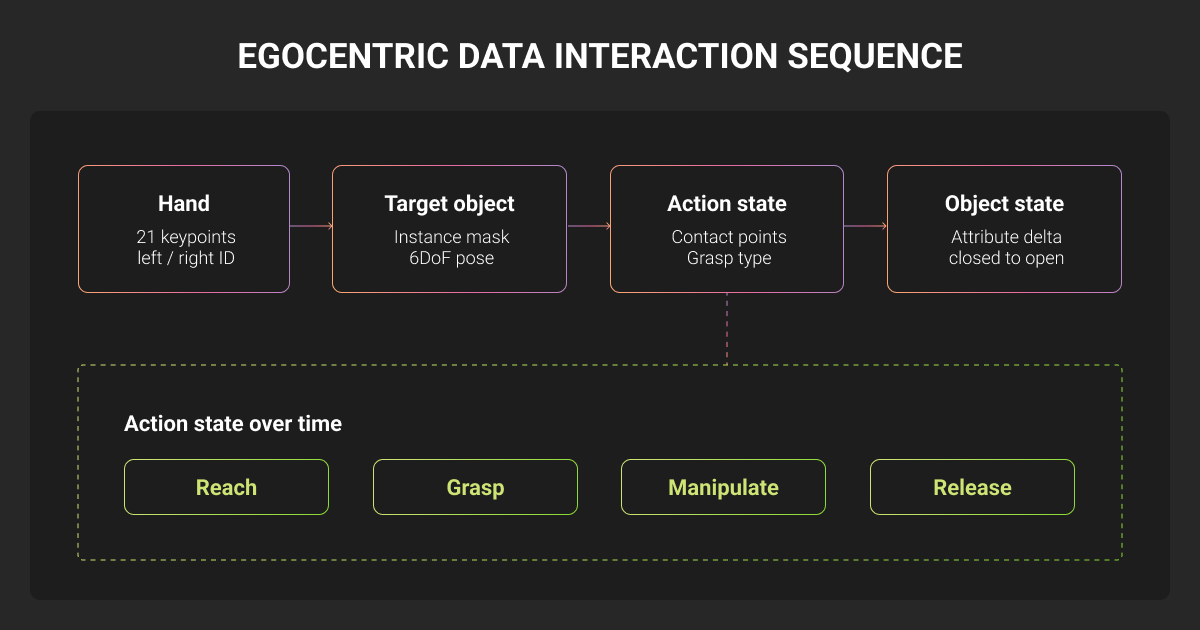
That sequence becomes usable training data only when several things get labeled at once. For each frame, egocentric data robotics models must determine:
- Target reaching intent
- Exact contact moments
- Active manipulation hands
- Tool applications
- Physical state shifts
Temporal context requirement for actions
Isolated frames fail to capture complete first-person actions. Picking up an item, opening a door, or assembling a part unfolds over continuous time. For a model to predict outcomes and judge whether an action succeeded, there must be clear boundaries for action start points, contact instances, initial states, final states, and upcoming steps.
Where First-Person Egocentric Data Is Used in AI
Egocentric data for model training directly powers next-generation spatial computing and physical automation systems. Capturing visual streams from the actor’s exact viewpoint gives onboard perception systems the training ground truth they need to operate correctly in real-world environments.
Wearables and AR/VR
Smart glasses and spatial headsets observe the physical world from the user angle. Egocentric data mirrors this deployed perspective. It gives onboard models you build the exact visual view they need to process in real time.
To provide meaningful context, an onboard machine learning algorithm must master several visual tasks:
- Hand-object interaction tracking
- Real-time activity recognition
- Smart object retrieval
- Spatial awareness and assistance
- Step-by-step procedural guidance
- Anticipation of immediate user actions
A headset must map spatial coordinates and recognize which tool a user plans to pick up next.
Robotics
Physical data capture on actual hardware is slow and expensive. Recording human egocentric video data provides complex manipulation examples at a scale manual teleoperation cannot match.
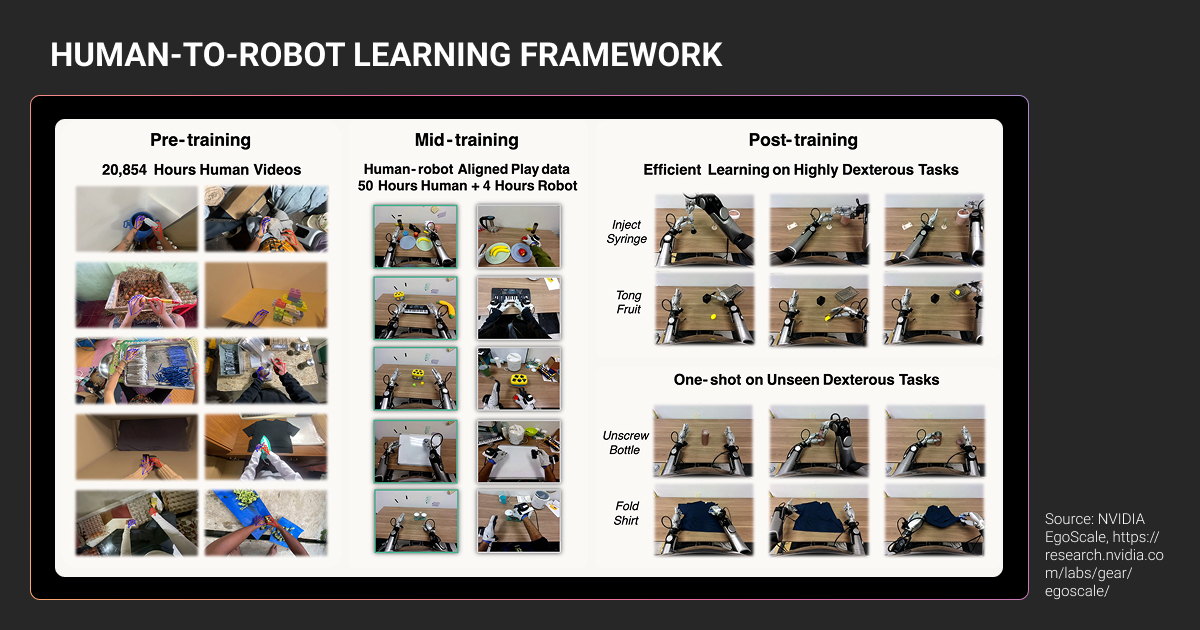
Case in point, the NVIDIA EgoScale framework uses massive human video archives as a pretrain source for vision-language-action models. This approach is exactly why embodied systems don’t rely solely on physical robot runs since they learn spatial movement and tool use directly from human activity.
In NVIDIA’s experimental setup, researchers found this pretraining step boosted robot manipulation success rates by 54% over a baseline with no pretraining. Models learned how objects respond to manipulation before fine-tuning on specific hardware.
Where Does Egocentric Training Data Come From?
Are you a CV engineer or a product lead in AR, wearables, or robotics? When it comes to training perception models, you rely on two main data sources. Public egocentric datasets give you broad baselines to test ideas fast. Custom egocentric robot data from internal tests gives you direct control over precise edge cases. But here’s more.
Public research egocentric datasets
Public benchmarks like Ego4D dataset are open-access repositories that give you immediate, low-risk options to evaluate new model architectures.
With public egocentric data, you can pretrain foundational vision backbones, run academic research, and conduct initial feasibility tests before investing in hardware rigs and paid annotation for your own dataset.
| Public dataset source | Dataset size and features | Use case |
| Ego4D | 3,025+ recorded hours across 9 nations, featuring 855 wearers in 74 unique environments. | Ego4D is the primary public benchmark for unscripted, everyday first-person human activity (ego-only). |
| Ego-Exo4D | 1,286 total hours from 740 subjects across 13 cities and 123 distinct settings (Launched Dec 2023). | The dataset pairs synchronized first-person and multi-angle third-person video of complex physical skills. Integrates spatial point clouds, gaze vectors, IMU tracking, spatial poses, and domain-expert commentary. |
| EPIC-KITCHENS | Several hundred hours capturing real-world, unscripted culinary environments. | This dataset focuses specifically on detailed fine-grained manipulation, with a comprehensive taxonomy for hand-object interactions and action verbs. |
| Project Aria | Specialized hardware platform (Meta research smart glasses). | Project Aria is a hardware capture framework. It records aligned gaze, spatial depth, audio, and inertial data alongside video. |
Custom and commercial egocentric data collection
Production-grade devices eventually face limits when you train them exclusively on public data. They generate different proprietary visual streams that you get during beta testing, targeted field captures, or internal deployments.
Custom egocentric video data offers stronger alignment advantages over off-the-shelf options:
- Matches deployment hardware optics
- Focuses on specific use cases
- Delivers custom annotation schemas
- Isolates known failure points
Think of commissioning custom egocentric data collection when you need total control over task routines, environmental lighting, exact camera optics, and unique product failure modes.
Specialist egocentric data companies like Label Your Data offer no-cost pilots to test the quality and transparent data annotation pricing.
How to Prepare Egocentric Data for Perception Model Training
Preparing raw egocentric footage for first-person AI requires a structured pipeline that links continuous video frames to precise physical actions.
As said, you may source raw footage across spatial, interaction, and temporal dimensions for production-grade training data internally or through a specialized egocentric data annotation company. But you will need specialized egocentric data annotation.
Object-level spatial annotation
Static labels fall short when objects move constantly in relation to the camera lens. Depending on your model’s exact task requirements, this spatial layer relies on these egocentric data annotation types:
- Bounding boxes for standard object detection pipelines where quick, low-cost spatial location of tools or equipment is required across frames.
- Segmentation masks when models require exact pixel-level boundaries for complex, irregularly shaped items or precise spatial geometry.
- Object classes for semantic categorization, distinguishing specific tools, parts, and environmental items within a shared scene.
- Track IDs to maintain a single identity for an object over time as it moves through the interaction sequence.
- Occlusion/visibility states for quantifying what percentage of a target item is hidden when hands or tools partially block it from view.
Working with egocentric robot data, you will encounter challenges to maintain persistent object tracking performance, such as target items routinely exiting the frame during quick head turns, while hands and tools constantly masking parts of the object.
Egocentric data annotators must be trained to re-identify the exact same object instance when it re-enters the field of view. They must also track visibility percentages frame by frame. Without this precise spatial continuity and expert annotation support, object detectors fail to maintain state across complex physical tasks.
Hand-object interaction annotation
First-person AI models must interpret what a user is doing with an item, not just where it sits in space. Labeling these interactions requires a detailed egocentric data annotation schema:
- Left/right hand: Identifies which hand performs the action and distinguishes the primary active hand from the secondary supporting hand.
- Active object: Flags the exact item directly manipulated during the recorded action sequence.
- Tool:. Distinguishes an object held to act upon another item, such as a driver turning a screw.
- Contact: Marks the exact initial frame where physical touch begins and the release frame where touch ends.
- Interaction type: Categorizes functional movement classes like grasping, pushing, lifting, or passing.
- Object state before/after: Documents physical transformation transitions, such as an uncut piece of material becoming a cut piece.
The Ego4D dataset shows how granular this gets: each interaction is broken into three timestamped frames — pre-contact, point-of-no-return, and post-contact — with bounding boxes and verb/noun labels attached to every one. Beyond those frame markers, annotators also track hand vectors, grasp modes, and spatial trajectories throughout the clip, not just at the three key moments.
Without this detailed interaction layer, egocentric models cannot learn the subtle physical mechanics needed to support AR step guidance or predict robotic tool use.
Temporal and action annotation
First-person predictive systems rely on continuous temporal context using egocentric video data with specific action labels across time:
- Precise boundary marks with start and end that isolate specific atomic actions
- Broader temporal clips that group related action units into complete workflow phases
- Chronological step order to map procedural routines
- Exact frame instances where physical hand-to-object contact begins or ends
- Key temporal markers to record physical shifts, such as raw food that becomes a prepped meal
- Time-aligned text descriptions to explain user intent and action details for vision-language models
A robot manipulation policy, an AR spatial assistant, and a wearable object retrieval system can all use the same raw video stream. Still, each system demands a different label structure for accurate real-world deployment.
Detailed egocentric data annotation demands significant internal team bandwidth. But you can leverage external egocentric data annotation services and focus on core model deployment while annotation experts at Label Your Data handle the training data for you.
About Label Your Data
If you choose to delegate egocentric data annotation, run a free data pilot with Label Your Data. Our outsourcing strategy has helped many companies scale their ML projects. Here’s why:
 Data Annotation for Complex Environments
Rely on consistent, high-quality output for complex datasets, detailed taxonomies, and edge cases.
 Structured Quality From Pilot to Production
Get quality engineered into every step through onboarding, evolving guidelines, QA, and continuous feedback.
 Flexible and Scalable Operations
Adjust team capacity, project size, and delivery model as you scale, with no setup fees or long-term lock-ins.
 An Integrated Delivery Partner
Align on goals, workflows, and expectations with a team that integrates into your process from day one.
 Projects Led by Annotation Experts
Work with former annotators who understand annotation complexity, quality standards, and high-volume delivery.
FAQ
What is egocentric data collection?
Egocentric data collection is the process of recording visual, audio, spatial, or sensor streams from a first-person device mounted directly on a human or robot.
What is the difference between egocentric and exocentric data?
Egocentric data, or first-person data, captures scenes directly from the actor’s moving perspective, while exocentric data, or third-person data, captures scenes from a fixed or external third-person viewpoint.
What is meant by egocentric in computer vision?
In computer vision, “egocentric” describes sensors, cameras, and datasets centered entirely on the visual perspective and physical movement of the wearer at any given moment. This sets it apart from third-person or 'exocentric' data, which captures a scene from an outside, stationary vantage point.
Written by
CEO of Label Your Data
Karyna is the CEO of Label Your Data, a company specializing in data labeling solutions for machine learning projects. With a strong background in machine learning, she frequently collaborates with editors to share her expertise through articles, whitepapers, and presentations.