


 Back to blog
Golden Dataset: How to Build Trusted AI Evaluation Data

 CEO of Label Your Data


Table of Contents

- TL;DR
- What Is a Golden Dataset in AI?
- What Makes Golden Datasets Trustworthy?
- How to Build a Golden Dataset for AI Evaluation
- Using Golden Datasets for LLM and RAG Evaluation
- Golden Datasets vs Synthetic Test Sets for RAG QA
- Keeping Golden Dataset Testing Reliable Over Time
- About Label Your Data
- FAQ

TL;DR
- A golden dataset defines the expected behavior you use to evaluate an AI system.
- Trusted references need clear annotation guidelines, review, and a process for resolving disagreements.
- Test typical requests and difficult cases separately so you know what each score measures.
- Synthetic examples can fill coverage gaps after reviewers validate their accuracy and relevance.
- Compare releases against the same dataset and evaluator versions, then update the benchmark as requirements change.
How do you build a reference dataset that lets you trust your AI evaluation results enough to act on them?
Ideally, a higher score should help you decide whether to implement a prompt change, switch models, or investigate any regressions. But things get complicated when the reference answers have mistakes or the test cases don’t reflect what your users are actually asking for.
That’s where a golden dataset comes into play, providing a solid standard for those decisions. Building a useful golden data set requires careful thought about coverage, annotation, review, and scoring.
This guide will walk you through those choices, with guidance on testing LLM and RAG systems and keeping your evaluation data reliable over time.
What Is a Golden Dataset in AI?
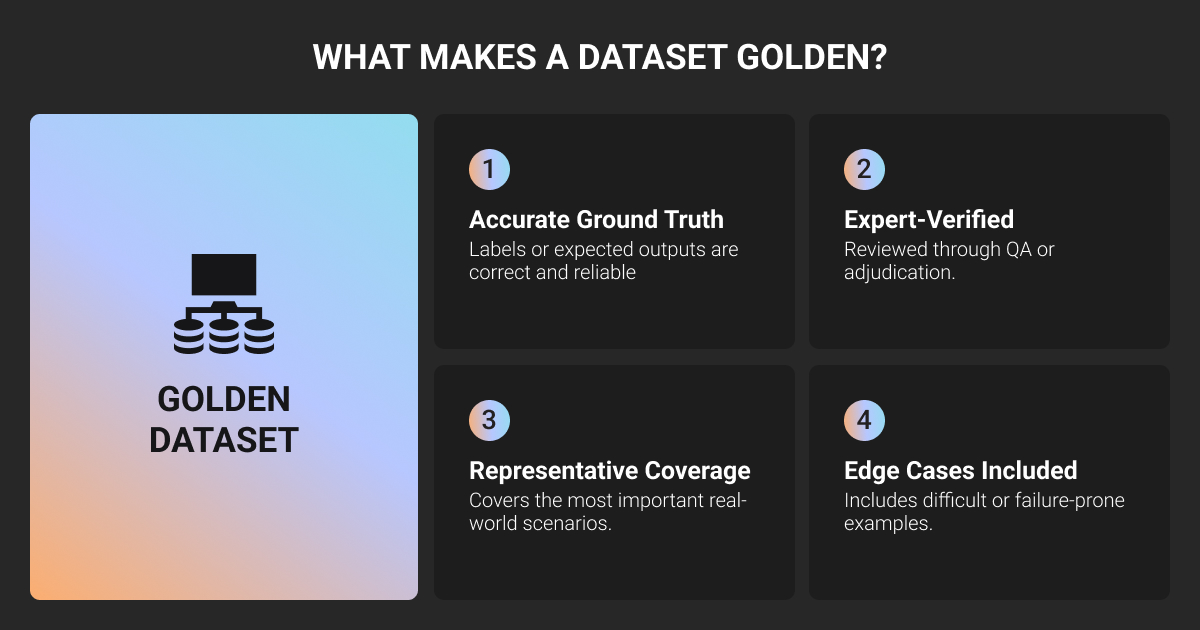
A golden dataset is a curated collection of test inputs with verified reference outputs or explicit acceptance criteria that you use to evaluate an AI system. Teams also call it a gold set or gold standard dataset.
A golden dataset machine learning teams can trust contains verified references such as class labels, object boundaries, factual answers, or expected actions. For a large language model (LLM) application, an item might specify a question, supporting evidence, and the facts a correct response must communicate.
The golden dataset meaning is straightforward: your team has established a reference it trusts for a defined task. “Golden” describes that trust and intended use, but it doesn’t guarantee complete coverage or error-free labels.
Use separate machine learning datasets for training, validation, and final testing. Models learn parameter values from training data, while validation results guide choices such as hyperparameters and prompts. Reserve the held-out test set for evaluating the selected system.
Microsoft’s golden dataset guidance explicitly separates evaluation references from training, fine-tuning, and prompt context. In RAG, the application can still pull up valid source documents, but it shouldn’t have access to the evaluator's answer key.
What Makes Golden Datasets Trustworthy?
Golden datasets are trustworthy when reviewers can justify the reference labels or answers, test cases cover the intended model behaviors, and scoring rules match the task.
Annotation reviewers need shared rules. An annotation QA specialist needs clear guidelines for checking reference labels and answers.
In image recognition, for example, these should explain how to label partially obscured objects. In document question answering, the guidelines should distinguish unclear questions that need clarification from missing evidence that requires a partial answer or a statement that the sources don’t answer the question.
Define these rules before scaling data annotation.
Test cases must match the model behavior you’re evaluating. Representative samples of real model inputs help estimate everyday performance, while rare failure cases test difficult conditions.
Report these groups separately so results from deliberately difficult cases don’t misrepresent expected production performance.
Acceptance criteria must define a passing response. Two responses can express the same correct answer in different words. Some tasks require exact values or valid JSON; others need scoring rules for factual completeness and support from source evidence.
Define what counts as a pass before comparing models.
Consistent annotation, relevant test cases, and clear scoring make golden datasets in AI evaluation more trustworthy. When a score drops, you can identify which outputs failed and which requirements they missed.
How to Build a Golden Dataset for AI Evaluation
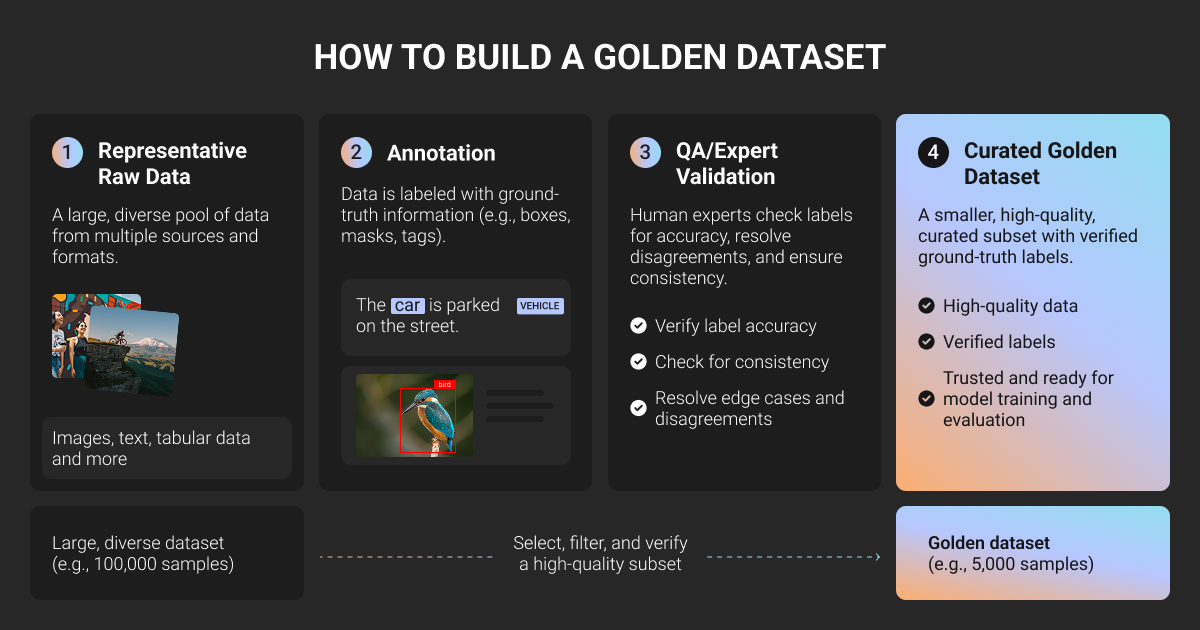
To build a golden dataset for AI evaluation, define the model behavior you need to test, collect representative inputs, and verify the reference labels or answers against documented rules.
Define the golden dataset’s scope
Specify the task, operating conditions, and errors you need to measure. For example, a pedestrian-detection model in a warehouse needs tests for missed people, incorrect detections, and inaccurate bounding boxes.
Decide whether you’re measuring performance under typical conditions or testing difficult scenarios, such as people partly hidden behind equipment. Keep these groups identifiable so you can report their results separately.
Collect examples that reflect real model inputs
Source data from the environments where your model will operate. Computer vision projects might use camera images, video sequences, or 3D point clouds; language and audio projects might use documents or recordings.
Select examples across the conditions that affect predictions. For warehouse pedestrian detection, these could include lighting, camera position, distance, and occlusion. Include images without pedestrians to check whether the model incorrectly detects people.
Check which scenarios you’ve covered before setting a dataset size. Many similar examples can leave entire failure types untested. Add examples for underrepresented scenarios, since dataset size alone doesn’t establish release readiness.
Write annotation and scoring guidelines
Give annotators and QA specialists clear rules for creating and checking reference labels. Your data annotation guidelines should define classes, required attributes, and how to handle ambiguous or unrecognizable inputs.
For object detection, specify whether boxes should cover only the visible part of an object or its estimated full extent. Include labeled examples that show how to apply the rule consistently.
Define model-scoring rules separately. For pedestrian detection, specify how predicted boxes match reference boxes and how you’ll count missed pedestrians, false detections, and duplicate predictions. Set acceptance thresholds around the application’s requirements before comparing models.
Review labels and resolve disagreements
Have an annotation QA specialist verify the reference annotations against the source data and guidelines. Use domain experts for specialist judgments and consider a specialist data annotation company like Label Your Data for managed annotation and QA support.
For ambiguous or consequential examples, add an independent second review. If reviewers disagree, check whether the cause is an annotation mistake, an unclear rule, or insufficient information in the input.
Assign a qualified reviewer to resolve the disagreement and document the decision. Update the guidelines when it affects other examples. If the evidence cannot support a reliable label, flag the item for further review rather than forcing agreement.
Model-assisted annotations can provide a starting point, but reviewers must verify them before treating them as reference labels.
Structure and validate golden dataset records
Give each item a stable identifier and link it to its input, reference annotation, and review history. Store the dataset’s annotation guidelines and scoring configuration alongside the records.
For example, a hypothetical pedestrian-detection record could contain:
| Field | What to record |
| Item ID | A unique identifier for the camera frame. |
| Source input | The image file, recording ID, and frame timestamp. |
| Reference annotations | Reviewed pedestrian bounding boxes and required attributes. |
| Test conditions | Low light, partial occlusion, or other relevant conditions. |
| Review history | Annotator, QA reviewer, review date, and resolved disagreements. |
| Versions | Dataset and annotation-guideline versions. |
Before release, check for missing annotations, invalid coordinates, duplicate items, and inconsistent class names. Run a trial evaluation and inspect apparent model errors; incorrect references or scoring logic can also cause failures.
Keep final evaluation examples separate from training data. For video annotation, check for near-identical frames across splits, not just duplicate filenames. If your team repeatedly uses golden dataset results to tune the model, reserve additional unseen examples for final assessment.
Save the approved dataset as a versioned release so subsequent comparisons use the same inputs and references.
Using Golden Datasets for LLM and RAG Evaluation
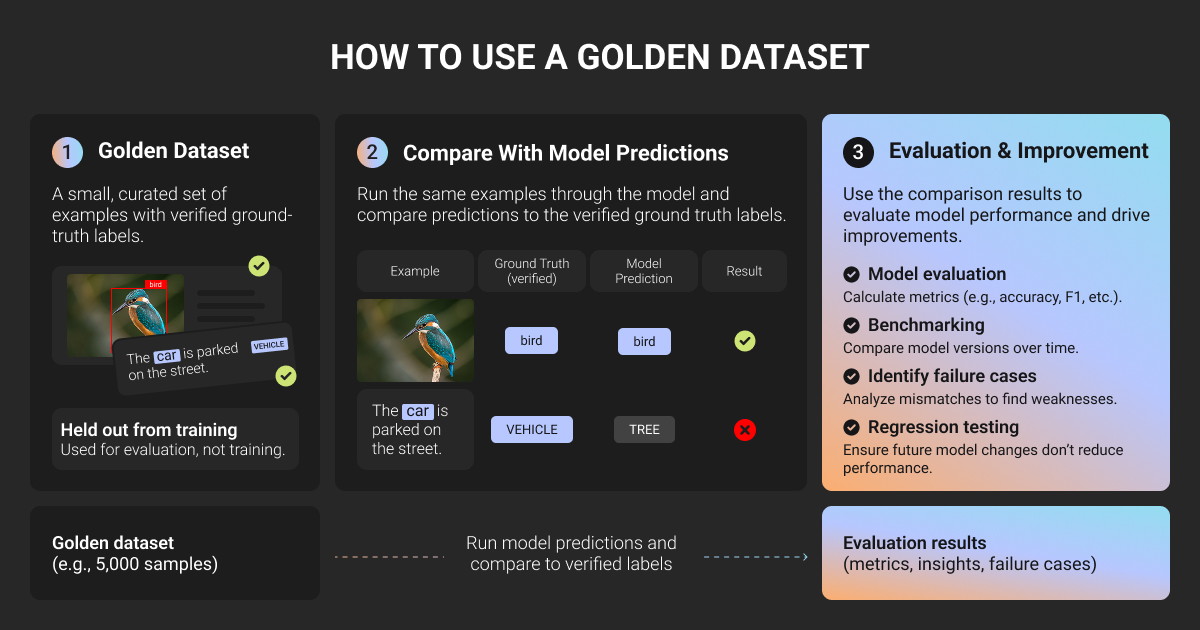
Use a golden dataset for LLM evaluation to check whether prompt or model changes improve task performance or introduce new errors. Compare each version against the same reviewed examples and scoring criteria.
For a classification task, you might compare predictions with verified labels when choosing a machine learning algorithm. Generated answers need more than a single label match: assess whether the response follows instructions, communicates the required facts, and avoids unsupported claims.
Separate retrieval from answer quality
Evaluate retrieval and answer generation separately to distinguish missing source evidence from errors in how the model uses the evidence it retrieves.
| Evaluation layer | What to check | Reference needed |
| Retrieval | Did the system retrieve the evidence needed to answer? | Relevant passages or documents, or verified answer facts. |
| Answer correctness | Does the response give the right answer for the request? | Verified answer facts or a reviewed answer, plus task-specific scoring criteria. |
| Faithfulness | Do the retrieved passages support the response's claims? | Actual retrieved context; a reference answer isn't always necessary. |
| Unanswerable requests | Does the system acknowledge insufficient evidence rather than invent an answer? | Defined expected behavior for that case. |
For example, Ragas distinguishes context recall, which checks coverage of relevant evidence, from faithfulness, which checks whether retrieved context supports the response. A faithful answer can still rely on an outdated document, so source freshness and answer correctness need separate attention.
Score meaning and essential requirements
Check whether the answer expresses the correct meaning, not just whether it contains expected terms. If an API requires authentication, “authentication is not required” includes the keyword but gives the wrong instruction.
Use code to validate formats, required fields, and exact values when appropriate. Use explicit rubrics for meaning and completeness, with human review to calibrate any LLM judge.
OpenAI’s evaluation guidance recommends aligning automated scores with human judgments.
Report failures such as unsupported factual claims or invalid JSON separately from average quality scores, so gains in fluency cannot hide errors that would block deployment.
Use Langfuse datasets and experiments
Experiments in Langfuse run your application against datasets containing inputs, optional expected outputs, and metadata. Changes to dataset items create new versions.
For a golden dataset comparison, select a fixed dataset version, run the baseline and candidate configurations, and apply the same evaluators. Inspect the cases that changed alongside aggregate scores, cost, and latency.
Keep the scoring rules and, if using an LLM judge, its model version and prompt fixed so evaluator changes do not distort the comparison.
If generation varies between runs, repeat relevant tests and examine the spread before treating a small improvement as dependable. A single favorable run on a golden dataset LLM teams use for evaluation isn’t enough to justify a release.
Golden Datasets vs Synthetic Test Sets for RAG QA
Reviewed synthetic data examples can belong in a golden dataset: “golden” describes the quality of the verified references, while “synthetic” describes how the examples were created.
For RAG QA, start with questions from real user interactions or user research, then generate synthetic examples for missing scenarios, such as unfamiliar terminology or questions about newly added documents. Langfuse recommends reviewing synthetic additions with the same rigor as real examples.
For implementation guidance, see this guide: Langfuse datasets experiments golden dataset.
| Choice | Useful for | Limitation to address |
| Reviewed production examples | Testing requests your users actually make. | Recorded user questions may omit new topics and rare failures. |
| Unreviewed synthetic candidates | Exploring possible questions and coverage gaps. | Plausible wording doesn't establish realistic demand or correct answers. |
| Reviewed synthetic examples | Testing rare scenarios and topics with few recorded user questions. | Record which examples are synthetic and verify that they reflect plausible user questions. |
Questions generated directly from documents may closely follow their wording and overlook questions those documents cannot answer. Include paraphrased questions, questions requiring evidence from multiple documents, and questions with no answer in the available sources.
Keeping Golden Dataset Testing Reliable Over Time
Keep golden dataset testing reliable by versioning dataset changes and updating references when task requirements change. Assign an evaluation owner to approve additions, resolve reference errors, and retire obsolete examples.
Keep released versions unchanged and document the changes in each new release. If you add difficult cases, rerun the baseline and candidate against the new version; don't compare today's score with an old score from an easier set. Record model, prompt, evaluator, and source-corpus versions where they affect the test.
Review failures by category as well as overall score. If pedestrian detection improves in daylight but misses more people at night, the overall score can hide the decline. Inspect the predictions for those failures before approving the model update.
If your team starts tuning models or prompts against the final verification set, those examples become part of development. Keep them for regression testing and use a separate, unseen set for final evaluation.
Use production errors and user feedback to identify new test cases, then have an annotation QA specialist verify their reference labels, answers, or expected actions before inclusion. Recheck existing references when annotation guidelines, source documents, or task requirements change, and record the reason for each update.
If preparing and reviewing new reference examples is slowing your evaluation work, Label Your Data can support your team with managed data annotation services. Our annotation specialists follow your project guidelines, with custom QA to check labels and reference answers against your acceptance criteria.
For Guardrails AI, an AI safety software provider, public datasets missed relevant edge cases, and the internal team lacked annotation capacity. We labeled 1,000 sentences and extracted 5,764 factual claims in 3.5 weeks, delivering JSON-ready data for safety-filter development.
Explore our data annotation pricing and share your sample data and acceptance criteria to request a no-cost pilot before scaling.
About Label Your Data
Label Your Data is a specialist AI data partner for teams building AI systems in complex environments. If you choose to delegate data labeling, run a data pilot with Label Your Data. Our outsourcing strategy has helped many companies scale their ML projects. Here’s why:
 Data Annotation for Complex Environments
Rely on consistent, high-quality output for complex datasets, detailed taxonomies, and edge cases.
 Structured Quality From Pilot to Production
Get quality engineered into every step through onboarding, evolving guidelines, QA, and continuous feedback.
 Flexible and Scalable Operations
Adjust team capacity, project size, and delivery model as you scale, with no setup fees or long-term lock-ins.
 An Integrated Delivery Partner
Align on goals, workflows, and expectations with a team that integrates into your process from day one.
 Projects Led by Annotation Experts
Work with former annotators who understand annotation complexity, quality standards, and high-volume delivery.
FAQ
How to build a golden dataset?
- Define the task, expected behavior, and release criteria.
- Collect realistic inputs and identify missing scenarios.
- Write annotation rules and create reference answers or labels.
- Review the references and resolve disagreements.
- Check coverage, duplicates, and overlap with training or tuning data.
- Version the dataset and validate the scoring process.
What is a golden dataset used for in LLM evaluation?
A golden dataset provides trusted test cases for comparing model or prompt versions, checking answer quality, and detecting regressions. It helps you assess whether the application meets defined requirements before and after a change.
What are golden sets?
Golden sets are curated collections of examples with reviewed labels, answers, or acceptance criteria. Teams use them to check model outputs or calibrate human annotation against an agreed standard.
What is the golden data set?
A golden data set is a trusted reference collection for a specific task. In AI evaluation, it records test inputs and the expected outputs or criteria used to judge model outputs. “Golden data set” and “golden dataset” refer to the same concept here.
What are gold standard datasets?
Gold standard datasets contain reference annotations or answers that annotation QA specialists or domain experts have validated. Their value depends on the task, guidelines, evidence, and review process; the name alone doesn't establish quality or suitability for your application.
Written by
CEO of Label Your Data
Karyna is the CEO of Label Your Data, a company specializing in data labeling solutions for machine learning projects. With a strong background in machine learning, she frequently collaborates with editors to share her expertise through articles, whitepapers, and presentations.