


 Back to blog
Best Image Annotation Services for Computer Vision

 CEO of Label Your Data


Table of Contents

- TL;DR
- Quick Overview of Top Image Annotation Service Providers
- Label Your Data: Best Image Annotation Services for Complex CV Projects
- iMerit: Best for Medical Imaging and Specialized CV Annotation
- Sama: Best for High-Volume Autonomous Systems Annotation
- CloudFactory: Best for Platform-Led AI Projects With Annotation Needs
- Cogito Tech: Best for Medical Scan Segmentation
- Keymakr: Best for Dedicated Annotators and Integrated Tooling
- BasicAI: Best for AI-Assisted Image Annotation With Human Review
- Humans in the Loop: Best for Geospatial Image Segmentation
- Scale AI: Best for Enterprise-Scale CV Data Operations
- TELUS Digital: Best for Large-Scale Automotive and Multisensor Annotation
- How to Evaluate Image Annotation Services
- About Label Your Data
- FAQ

TL;DR
- The best image annotation service provider depends on your dataset’s complexity, quality requirements, workflow compatibility, and delivery needs.
- Label Your Data specializes in custom annotation for complex CV projects, iMerit in medical imaging, and Sama and TELUS Digital in large-scale automotive projects.
- CloudFactory’s growing focus on enterprise AI consulting and platforms may be more extensive than necessary for standalone image annotation.
- Customer reviews highlight occasional labeling and onboarding issues with Keymakr and platform usability concerns with Sama.
- iMerit’s acquisition by EXL introduces potential integration risks around data governance and commercial terms, making careful vendor evaluation important.
Outsourcing image annotation should free up your engineering team, not leave them fixing inconsistent labels, reviewing the same batches repeatedly, or chasing missed deadlines. Yet these are exactly the kinds of problems that can turn an annotation project into a costly, time-consuming process.
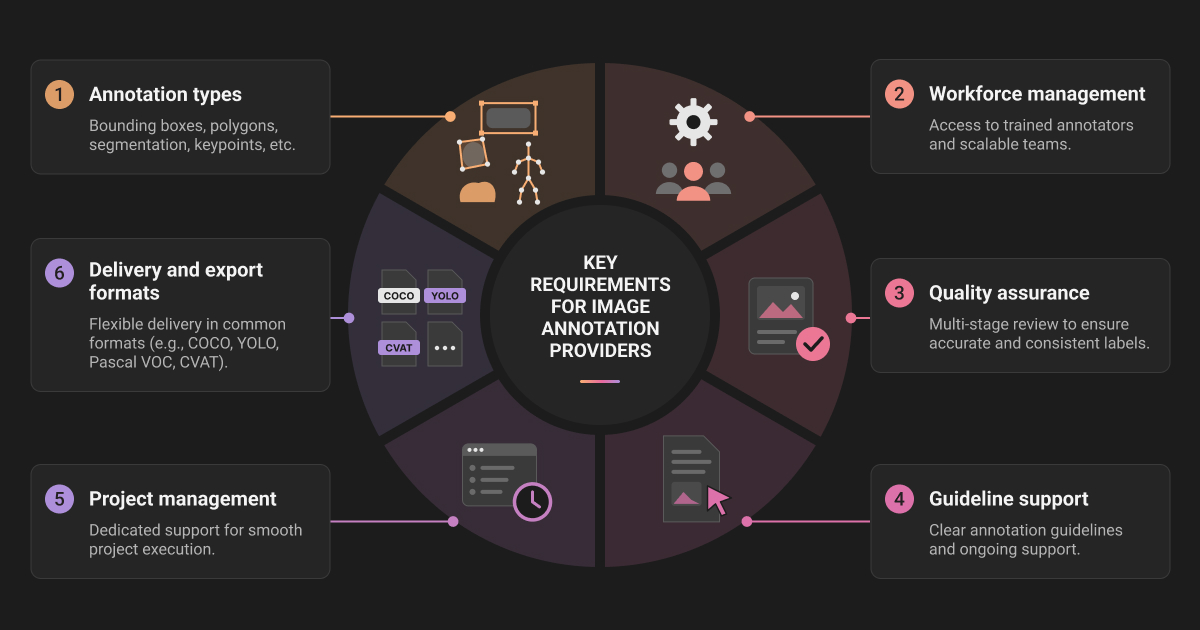
Choosing the right provider takes more than comparing data annotation pricing and supported labeling techniques. You also need to understand how each company handles quality control, complex datasets, changing requirements, and production volumes.
In this guide, we compare ten best image annotation service providers based on their technical expertise, delivery models, and real project experience. You’ll learn which companies are best suited to different computer vision projects and what to check before choosing a partner.
Quick Overview of Top Image Annotation Service Providers
The top image annotation service providers in 2026 include Label Your Data, iMerit, Sama, CloudFactory, Cogito Tech, Keymakr, BasicAI, Humans in the Loop, Scale AI, and TELUS Digital.
All ten offer managed annotation services, but their expertise, QA processes, and delivery models differ. Choosing the right one means finding a team that can handle your dataset’s complexity, meet delivery deadlines, and work within your existing workflows without creating extra work for your engineers.
Here’s how these providers compare and which computer vision projects they’re best suited for.
| Provider | Best for | Service model | Key strength |
| Label Your Data | Complex CV projects across high-stakes industries with custom annotation requirements | Managed services with flexible tooling + self-serve platform | Custom QA, enterprise-grade security, tool-agnostic workflows, and flexible engagement |
| iMerit | Medical imaging and specialized CV annotation | Domain-trained teams + Ango Hub | Domain expertise and multi-stage quality checks |
| Sama | High-volume annotation for autonomous systems | Managed services + proprietary platform | Large-scale delivery with human-in-the-loop QA |
| CloudFactory | Projects requiring managed teams within existing workflows | Managed annotation workforce | Experience working with client-developed annotation tools |
| Cogito Tech | Medical imaging and specialized 2D annotation | Managed annotation services | Industry-specific labeling and a range of annotation techniques |
| Keymakr | Projects requiring dedicated annotation teams | In-house teams + Keylabs platform | In-house annotators and four-stage QA |
| BasicAI | AI-assisted annotation with human review | Managed services + proprietary platform | Automated labeling tools combined with human verification |
| Humans in the Loop | Geospatial imagery and segmentation | Human-powered managed services | Geospatial annotation experience and ethical employment practices |
| Scale AI | Large enterprise CV datasets | Managed services + Data Engine | Integrated data annotation, curation, and evaluation workflows |
| TELUS Digital | Large-scale image and multisensor annotation | Global workforce + Ground Truth Studio | Global delivery capacity and specialized annotation teams |
Let’s take a closer look at what each provider offers and what to consider before making your choice.
Read also: Image Annotation Tools: Features, Pricing, and Ease of Use Compared
Label Your Data: Best Image Annotation Services for Complex CV Projects
Label Your Data is a trusted AI data partner that provides managed image annotation services for computer vision teams working with complex datasets, custom labeling requirements, and challenging edge cases.
The company supports bounding boxes, polygons, keypoints, and image segmentation across industries such as autonomous systems, robotics, manufacturing, energy, defense tech, construction, and geospatial AI. Its teams can work in your existing annotation platform or their own, with custom QA processes to maintain consistency and reduce rework as project requirements change. Label Your Data also offers a self-serve annotation platform for computer vision teams that prefer to handle labeling in-house.
Trusted by over 200 AI and ML teams, Label Your Data holds a 5.0/5 rating on Clutch from 27 reviews and 4.9/5 on G2 from 21 reviews. Its project experience includes annotating approximately 60,000 objects for Nodar, a company developing 3D depth perception software. The project involved complex polygon annotations, with a team of 10-20 annotators and 2-3 QA reviewers. For KAUST’s AI research, the team completed aerial palm tree polygon annotation in 17 days, achieving over 98% client-verified accuracy.
What to consider: Label Your Data offers a no-cost pilot to test annotation quality, workflow compatibility, and delivery expectations on your own dataset before committing to production. No long-term contracts required.

The single thing that separates a great annotation provider from a forgettable one is how they handle ambiguity. Every CV project has edge cases. Blurry frames, overlapping objects, weird lighting. The providers worth rehiring are the ones who build a feedback loop around those edge cases instead of just guessing or flagging everything and stalling your pipeline.

 CEO, Magic Hour AI
iMerit: Best for Medical Imaging and Specialized CV Annotation
iMerit provides managed image annotation services for complex computer vision projects, with particular expertise in medical imaging. Its teams handle bounding boxes, polygons, keypoints, and image segmentation for applications ranging from autonomous systems to healthcare AI.
The company combines domain-trained annotators, specialist reviewers, and its proprietary Ango Hub platform. Its workflows include annotator training, calibration against reference data, and two-stage QA to catch labeling errors before delivery.
For example, iMerit supported a medical AI project involving the segmentation of 5,000 pelvic CT scans and 5,000 MRI scans. The team combined specialized medical annotators with radiologist-led quality checks and clinical validation to support regulatory requirements.
In August 2026, EXL completed its acquisition of iMerit, bringing the company into its broader enterprise AI operations.
What to consider: While the acquisition could expand iMerit’s resources, it also brings potential risks around data governance, access permissions, pricing, and contract terms as the companies integrate. Buyers should also consider possible changes to account management and annotation workflows.
Read also: iMerit Review: A Deep Dive into Vendor, Pricing, and Key Alternatives
Sama: Best for High-Volume Autonomous Systems Annotation
Sama provides managed image annotation services for large-scale computer vision projects, particularly in autonomous driving, ADAS, and industrial automation. Its teams handle bounding boxes, polygons, keypoints, and semantic segmentation through a proprietary annotation platform.
The company uses dedicated in-house annotators, project-specific training, and a combination of automated checks and human QA. Its calibration process helps teams agree on labeling rules and quality standards before production, reducing the risk of inconsistent annotations and costly rework.
In one automotive OEM project, Sama annotated millions of samples for object detection, tracking, and semantic segmentation. The team established a quality rubric with a two-pixel tolerance and reported meeting a 98% quality SLA, demonstrating its experience with demanding annotation requirements at scale.
What to consider: Sama’s proprietary platform may require additional integration planning for teams using existing annotation tools. Some G2 reviewers have reported challenges with Sama’s platform, including a steep learning curve, the need for specialized training, and occasional service interruptions. These issues may add complexity for teams that need direct platform access or have tight delivery schedules.
Read also: Sama Company Review: Strengths, Weaknesses, and Considerations
CloudFactory: Best for Platform-Led AI Projects With Annotation Needs
CloudFactory focuses on enterprise AI consulting and platform-based solutions, with data annotation offered as part of its broader services. Its AI platform combines data preparation, model management, and human oversight to help businesses develop and run AI systems in production. While CloudFactory has extensive experience with managed image annotation, its current offering goes beyond standalone labeling services.
Its image annotation experience spans object detection, segmentation, and geospatial imagery. CloudFactory has also supported clients using their own annotation tools. For example, in a project for Nearmap, its managed teams completed over 300,000 hours of aerial image annotation, helping the client scale its labeling operations tenfold.
What to consider: CloudFactory’s focus on enterprise AI platforms and consulting may be more extensive than necessary for teams seeking only outsourced image annotation. Some client feedback also raises concerns about pricing predictability, making the scope and cost of standalone labeling services important considerations.
Read also: Label Your Data vs CloudFactory: Data-Backed Comparison for ML Teams
Cogito Tech: Best for Medical Scan Segmentation
Cogito Tech provides managed data annotation services for computer vision, NLP, and generative AI projects. Its image annotation expertise covers several industries, with documented experience in medical imaging, including CT, PET, and dental CBCT scans.
The company offers bounding boxes, polygons, keypoints, and image segmentation, including complex volumetric annotations. Its managed teams combine trained annotators, domain specialists, and multi-level quality checks, using third-party or client-provided annotation tools.
In one healthcare project reviewed on G2, Cogito Tech annotated approximately 3,000 PET/CT cancer scans to support automated segmentation models. Another medical technology client reported using its team for coronary CT angiography annotations and volumetric segmentation.
What to consider: While reviews are generally positive, some clients have reported annotation inconsistencies, requests for more thorough quality checks, and occasional delivery delays. These concerns matter particularly for medical imaging projects where precise annotations and specialist review are essential.
Keymakr: Best for Dedicated Annotators and Integrated Tooling
Keymakr provides managed image annotation services through dedicated in-house teams and its proprietary Keylabs platform. The company focuses on computer vision projects that need consistent labeling, human review, and access to integrated annotation tools.
Its services cover bounding boxes, polygons, keypoints, and image segmentation for applications including automotive, robotics, manufacturing, and retail. Keymakr combines AI-assisted annotation with four levels of human-led QA to review and correct labeling errors.
In a project for Deep Safety, Keymakr processed over 16,000 frames for an industrial perception system. The work involved detailed segmentation of workers, equipment, and infrastructure in crowded environments, with the annotation team scaling to 50 specialists.
What to consider: While client reviews are generally positive, some customers report recurring annotation errors, initial setup difficulties, and challenges integrating Keylabs with existing workflows. These issues may add review and onboarding work for projects with complex labeling requirements.
BasicAI: Best for AI-Assisted Image Annotation With Human Review
BasicAI offers fully managed image annotation services alongside its proprietary AI-powered labeling platform. It’s particularly suited to computer vision teams looking to speed up repetitive labeling tasks while keeping human oversight of annotation quality.
The company supports bounding boxes, polygons, keypoints, and semantic and instance segmentation. Its managed services combine AI-assisted labeling, automated quality checks, and multi-stage human review. Each project also receives a dedicated manager, with annotators trained on the client's requirements. The platform supports common output formats, including COCO and YOLO.
In one robotics project, BasicAI annotated images and point clouds covering over 100 North American home environments. The team labeled walls, doors, furniture, and obstacles to support robot vacuum navigation models.
What to consider: BasicAI’s managed services rely on its proprietary tooling. Some G2 reviewers have reported slow task loading and limited customization options. These platform-related concerns may matter for teams with established annotation workflows or specific integration requirements.
Humans in the Loop: Best for Geospatial Image Segmentation
Humans in the Loop provides managed image annotation services, with particular experience in aerial and satellite imagery. The company also operates as a social enterprise, creating paid digital work for people affected by conflict and displacement.
Its teams handle bounding boxes, polygons, keypoints, and semantic and instance segmentation. The company supports client-selected annotation tools and custom output formats, with a two-layer QA process involving independent supervisors.
In a project for Restor, Humans in the Loop used polygon annotation to segment individual trees in aerial imagery. The team flagged ambiguous images and delivered annotations in COCO format to support Restor's forest monitoring models.
What to consider: Humans in the Loop works with distributed annotation teams across several countries, making data access locations and permissions important considerations for sensitive datasets. Its G2 profile also has no customer reviews, leaving limited independent public feedback on service quality and delivery consistency.
Read also: Humans in the Loop Company Review: Is It Your Next Fit?
Scale AI: Best for Enterprise-Scale CV Data Operations
Scale AI provides managed data annotation services for large computer vision projects, particularly in autonomous driving, robotics, and other applications requiring complex training machine learning datasets. Its Data Engine combines human annotation, AI-assisted labeling, data curation, and model evaluation in one platform.
The company supports image and video annotation, including bounding boxes and semantic segmentation, alongside 3D sensor fusion. Its workflows help enterprise teams manage large datasets, identify difficult cases, and prioritize annotations that may improve model performance.
Read also: Scale AI Competitors: Best Options for ML Teams
In a project with the U.S. Air Force, Scale AI labeled approximately 88,000 objects from video footage to train maritime vessel detection models. The team developed a custom label taxonomy and refined the dataset across two training cycles to reduce misclassifications and improve detection.
In June 2025, Meta acquired a 49% stake in Scale AI, raising concerns among some AI companies about competitive independence and data confidentiality.
What to consider: Meta’s significant ownership stake raises potential concerns about data governance and competitive confidentiality, particularly for teams developing proprietary AI models. Scale AI maintains that it operates independently and doesn’t share customers’ confidential information with Meta.
Read also: Label Your Data vs Scale AI: For ML Teams Evaluating Vendors
TELUS Digital: Best for Large-Scale Automotive and Multisensor Annotation
TELUS Digital provides managed image annotation services for enterprise computer vision projects, particularly autonomous driving and advanced driver-assistance systems (ADAS). Its global workforce and proprietary Ground Truth Studio platform support large-scale labeling across images, video, LiDAR, and other sensor data.
The company combines trained annotators, AI-assisted labeling, and multi-stage QA. Its services cover object detection, segmentation, keypoints, and 2D-3D sensor fusion, with configurable workflows for complex annotation requirements.
In a project for a European automotive manufacturer, TELUS Digital deployed over 500 annotators and delivered more than 51 million labels for autonomous driving models. The project achieved a fourfold productivity increase in 60 days while maintaining 99% average annotation recall.
What to consider: In March 2026, TELUS Digital disclosed a cybersecurity incident involving unauthorized access to some of its systems. There’s no confirmed public evidence that its annotation platform or labeling datasets were affected, but the incident raises relevant questions about data isolation, access controls, and security assurances for sensitive CV projects.
How to Evaluate Image Annotation Services
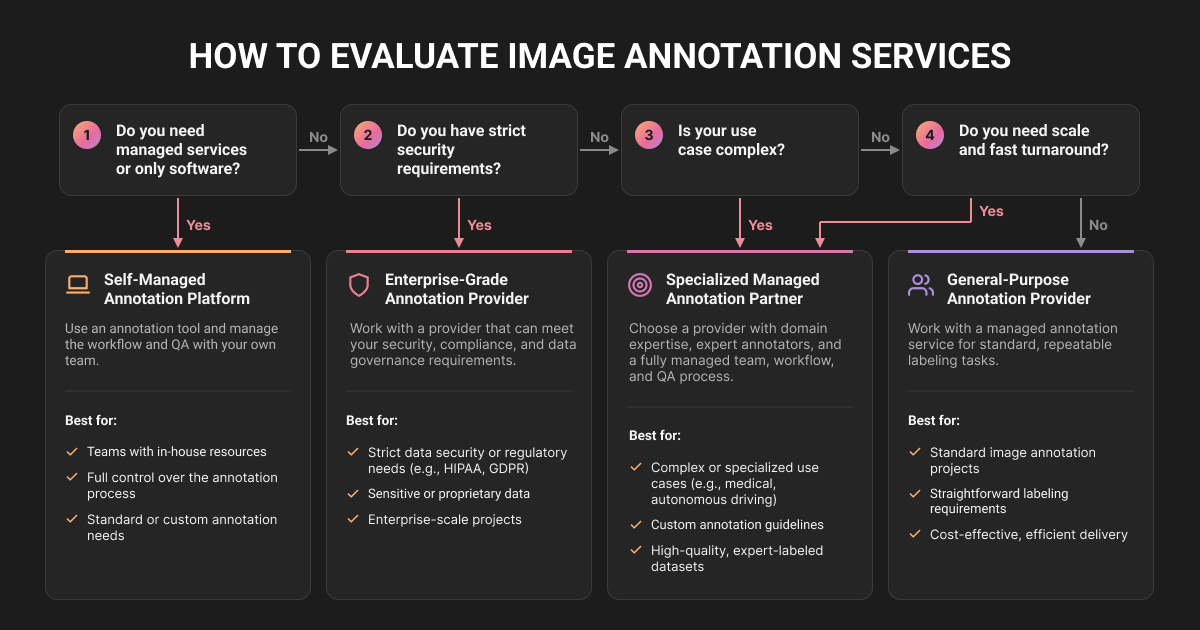
The best image annotation service is one that can meet your project’s quality requirements, fit into your existing workflows, and deliver consistent results at scale. Before choosing a provider, focus on three key areas:
Define your annotation requirements
Start with your model’s task. For example, image recognition for product classification may require image-level labels, while localizing defects may require bounding boxes or segmentation masks. Specify your taxonomy, edge cases, output formats, and measurable quality criteria before choosing a provider.
Assess delivery and QA capabilities
Look for relevant industry experience, trained annotators, clear review processes, and the ability to scale without sacrificing consistency. Check whether the provider supports your existing tools and how it handles guideline changes, corrections, and missed deadlines.
Run a representative pilot
Test providers on a small dataset that includes difficult cases, not just straightforward images. Compare data annotation accuracy, turnaround times, communication, and the amount of rework required before committing to larger volumes.
A successful pilot is encouraging, but the provider must also demonstrate that it can manage recurring batches without allowing quality or delivery consistency to deteriorate. I would also consider how straightforward the working relationship is. Clear responsibilities, an agreed process for handling exceptions, and a practical way to communicate changes can save considerable time for the client's own team.
 Co-Founder | AI & Data Annotation Solutions, Precise BPO Solution
A pilot can uncover quality and workflow issues that pricing quotes and service descriptions won’t reveal. You can start with a no-cost pilot from Label Your Data, a managed image annotation service provider trusted by over 200 AI and ML teams, including ABB, Ouster, and Boston University, to test its services on your own dataset before committing to production.
About Label Your Data
If you choose to delegate image annotation to a trusted AI data partner, run a no-cost pilot with Label Your Data. Our outsourcing strategy has helped many companies scale their computer vision projects. Here’s why:
 Data Annotation for Complex Environments
Rely on consistent, high-quality output for complex datasets, detailed taxonomies, and edge cases.
 Structured Quality From Pilot to Production
Get quality engineered into every step through onboarding, evolving guidelines, QA, and continuous feedback.
 Flexible and Scalable Operations
Adjust team capacity, project size, and delivery model as you scale, with no setup fees or long-term lock-ins.
 An Integrated Delivery Partner
Align on goals, workflows, and expectations with a team that integrates into your process from day one.
 Projects Led by Annotation Experts
Work with former annotators who understand annotation complexity, quality standards, and high-volume delivery.
FAQ
How much do image annotation services cost?
Image annotation pricing depends on annotation complexity, object density, dataset size, QA requirements, and turnaround times. Providers may charge per image, object, annotation hour, or project. For accurate comparisons, request quotes based on the same sample dataset and clarify whether quality reviews and corrections are included.
What should an image annotation service agreement include?
The agreement should define annotation requirements, delivery timelines, quality acceptance criteria, revision policies, and responsibilities for correcting errors. It should also specify data security obligations, confidentiality requirements, and how changes in project scope affect pricing.
Who owns the annotated data after outsourcing?
Ownership depends on the service agreement. Before sharing datasets, make sure the contract defines intellectual property rights, permitted data usage, confidentiality obligations, and what happens to source images and annotations after the project ends.
Can you switch image annotation providers without starting over?
Yes, provided you retain access to your annotations, taxonomy, and project documentation in transferable formats. Standard exports such as COCO or YOLO can simplify migration, although custom attributes and annotation rules may require additional conversion or validation.
Written by
CEO of Label Your Data
Karyna is the CEO of Label Your Data, a company specializing in data labeling solutions for machine learning projects. With a strong background in machine learning, she frequently collaborates with editors to share her expertise through articles, whitepapers, and presentations.