


 Back to blog
How to Scale Managed Data Labeling for Computer Vision

 CEO of Label Your Data


Table of Contents


TL;DR
- Scaling computer vision annotation requires a team of trained annotators and reviewers to deliver datasets that meet quality criteria and project deadlines.
- Evaluate providers through representative pilots that establish annotation quality, handling times, QA requirements, and realistic delivery expectations before scaling.
- Complex guidelines need documented edge-case decisions, version-controlled updates, and practical training, with significant changes checked before rollout.
- Compare internal and managed annotation costs using the same workload and acceptance criteria, including staffing, review, corrections, engineering oversight, and coverage.
- Label Your Data combines transparent pricing, tool-agnostic workflows, and human-in-the-loop annotation and QA to help teams scale complex computer vision annotation projects.
When your data annotation volume ramps up, simply adding more annotators isn’t a guaranteed way to move your next model training forward. In fact, a larger dataset can introduce new challenges for your team:
- A bigger dataset exposes edge cases your current guidelines don’t address
- New edge cases require extra training rounds for annotators to learn them
- QA reviewers struggle to keep up with more labeled data piling up
Your team ends up spending time fixing inconsistent labels and other annotation issues before your ML engineers can even start training and evaluating their models.
Automating part of that labeling workflow can increase output, but pre-labeling errors can lead to costly rework if human review capacity doesn’t keep pace. That’s why many computer vision teams often scale data labeling with managed service teams, like Label Your Data, that can take on complex labeling and review tasks they’ve honed over the years, freeing up your engineers to concentrate more on developing their models.
But not every annotation provider is built for scaling. You should evaluate how much reviewed data a managed partner can deliver on schedule while meeting agreed consistency and quality criteria under complex guidelines. You can also use this framework to evaluate and scale managed data labeling operations for computer vision and complex annotation workflows.
Evaluating Managed Labeling for Large-Scale CV Datasets
Evaluate managed data annotation services against four criteria: data modality, quality requirements, security standards, and project scale. The best AI training data providers need to deliver annotations that meet your acceptance criteria at the pace your model development requires.
📍 How to evaluate managed labeling providers for large-scale computer vision projects, especially whether they can maintain quality as volume grows? Compare managed data annotation service companies by their ability to deliver reviewed annotations that meet your dataset quality criteria, at the volume and pace your computer vision project requires. Check their experience with your data modality, high-volume computer vision annotation, QA process, security controls, and timeline for expanding production. |
Computer vision teams that move from pilot machine learning datasets to production volumes need a labeling partner whose quality holds as volume grows. Start by matching a provider to your data modality, quality requirements, security standards, and project scale.
Compare providers against your model and data requirements
Start with the work your dataset requires. Experience with image classification doesn’t establish whether a team can maintain object identities across video frames or annotate partially occluded objects in LiDAR data. So your team should test the annotation provider on representative samples from your dataset.
Use the following criteria to compare managed annotation services:
| What to compare | Evidence to request |
| Experience with your CV task | Comparable project examples and sample annotations that follow your rules for object boundaries, attributes, occlusion, or tracking. |
| Quality assurance | Who reviews annotations, how review coverage is determined, which errors are measured, and how corrections are checked before delivery. |
| Reviewed throughput | Expected weekly output for your task, with the annotation unit, acceptance criteria, and time for corrections clearly defined. |
| Ramp timeline | When additional annotators and reviewers will be ready for production, and what output they can support at each stage. |
| Security controls | Where data is stored and accessed, who can access it, whether subcontractors are involved, and how access and deletion are controlled. |
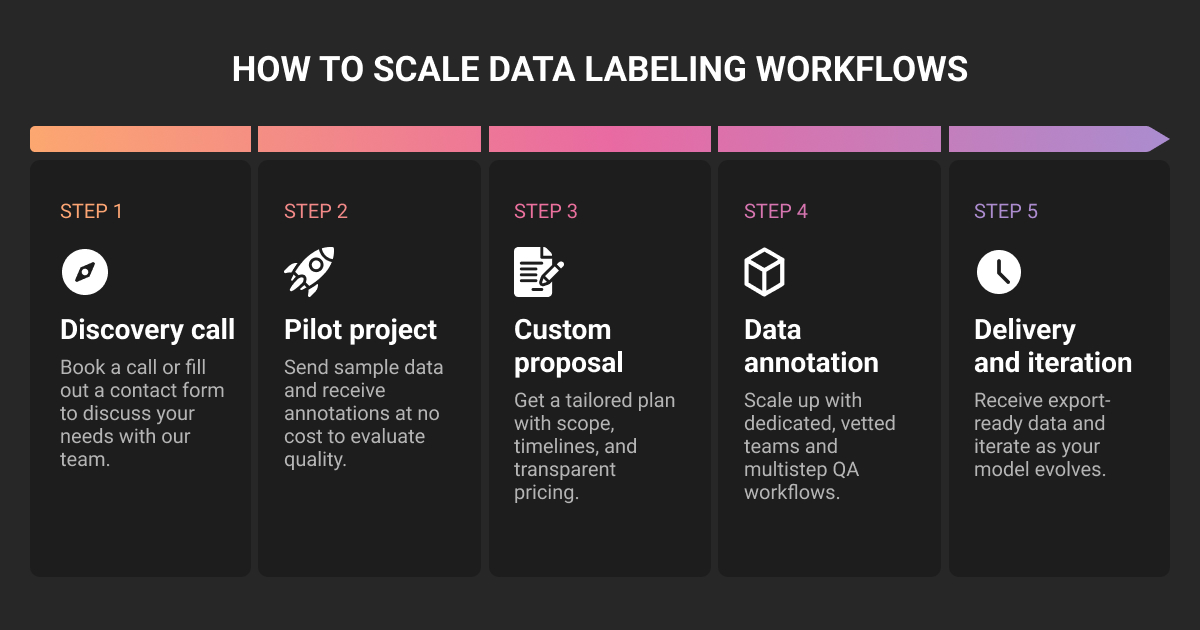
Ask a data annotation company when additional annotators and reviewers will be ready, how much reviewed data they can deliver each week, and which quality thresholds must hold before production increases. For example, Label Your Data offers a no-cost pilot that makes these commitments specific enough to assess.
Test annotation quality and delivery on the same workload
You can give each provider the same pilot samples, guidelines, output format, and acceptance criteria. But make sure to include typical data and difficult cases your team expects in production.
For an object detection project, assess missed objects, incorrect classes, and box placement separately. For video annotation, also check whether object identities remain consistent across frames. This makes the results more useful than a single accuracy percentage.
Compare four outcomes:
- First-pass acceptance: how much work meets your criteria without being returned for correction.
- Reviewed throughput: how many agreed units pass review within a defined period.
- Rework: how much correction is needed and how long it takes.
- Client effort: how much time your engineers spend answering questions and checking deliveries.
At Label Your Data, a Solutions Specialist reviews the sample data, annotation guidelines, tooling, and project requirements before the no-cost pilot. We use the results to assess annotation quality, handling times, productivity, and human-led QA requirements, then use those findings to inform the delivery plan and custom proposal for your project.
For complex AI projects, we may recommend an extended pilot with a dedicated team that lets you test the tooling, review process, and communication under production conditions, with regular checkpoints to assess results and adjust the workflow.
Check how annotation quality holds during scaling
Ask how the provider would maintain annotation quality as your dataset grows (for example, from 10,000 to 10 million annotations), and how long it would take to expand both labeling and review capacity without quality degradation. For a broader picture, you can also ask for a staged production plan showing when additional annotators and reviewers will be ready, the weekly reviewed output expected at each stage, and the quality thresholds required before increasing dataset volume.
📍 How should you compare managed data labeling services for large-scale computer vision datasets? Compare managed data labeling services by their experience with your computer vision task, reviewed throughput, QA process, ramp timeline, security controls, and total delivery cost. Label Your Data demonstrates this through projects such as Ouster, where the annotation team grew from two to ten while the client reported consistent quality. For Nexvision, the team annotated 70,000 images and 4,000 videos across three workflows, delivering on time with no major rework. Look for comparable evidence that a provider can expand delivery while meeting your quality requirements. |
Label Your Data supports large-scale and long-term computer vision annotation projects, adapting team capacity as data volumes and requirements change. For production ramp-up, we use short sprints so your machine learning team can review early outputs while we monitor quality and productivity.
We increase data labeling volume and team capacity gradually once quality consistently meets the agreed standards and you approve the expansion. Capacity estimates should also specify the unit, task complexity, review coverage, and time allowed for corrections.
As data batches grow, compare acceptance rates and error types against the pilot results while accounting for changes in dataset difficulty. If output increases but more work comes back for correction, the additional volume may not bring your next training run any closer.
Maintaining annotation consistency also depends on how the provider handles cases the guidelines don’t yet cover. Adding annotators also means teaching more people to apply the same rules. The Label Your Data team uses the pilot to identify missing instructions and ambiguous cases, then work with your team to clarify them. Those decisions become part of the working guidelines and training material, so new team members can learn from examples already resolved during the pilot.

The bottleneck that breaks teams at scale is not the annotation itself, it is the review layer sitting behind it. When volumes are small, a senior lead can personally catch edge cases and course correct in real time, but that process does not survive a jump to hundreds of thousands of images.

 Industrial Engineer
For Ouster’s LiDAR annotation project, Label Your Data successfully expanded the team from two to ten annotators, building project expertise before scaling and providing continuous training. Ouster’s Staff Software Engineer reported that annotation quality remained consistent as the project grew.
For the Nexvision project, we annotated 70,000 images and 4,000 videos across pupil segmentation, eye detection, and maritime tracking. Each workflow began with small pilot batches before production, and feedback informed subsequent batches. The datasets were delivered on time, with no major rework.
Label Your Data has also provided data annotation services for B2B platform SimplyDepo, completing 470,000 retail product images with bounding boxes and class labels. The client reported high-quality annotations delivered within agreed deadlines and placed additional orders.
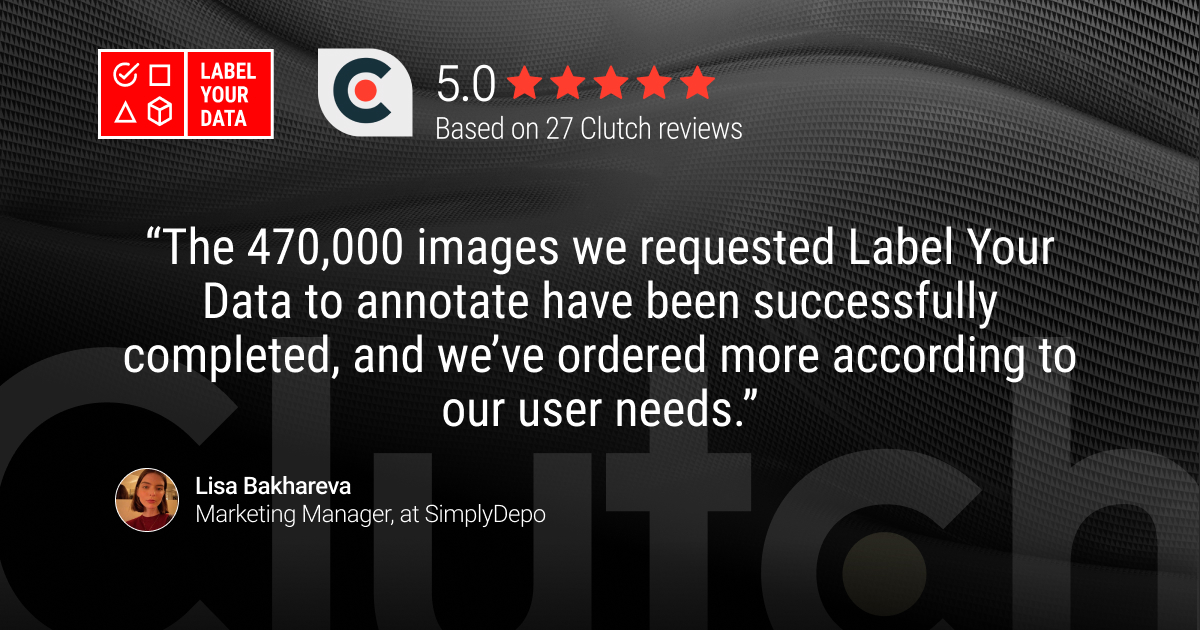
Read SimplyDepo’s full review of Label Your Data on Clutch.
Scaling With Complex, Custom Annotation Guidelines
Complex guidelines are where scaling projects most often break down. As the dataset grows, more edge cases emerge, and small ambiguities in the instructions produce inconsistent labels across batches. You need clear rules, documented edge-case decisions, and training that helps new annotators and reviewers apply both consistently, so choose a provider that builds these into onboarding through human-in-the-loop expertise for nuanced or custom labeling requirements.
📍 How to find a data labeling partner that scales well with complex, custom annotation guidelines? Choose a data labeling partner that tests your custom guidelines on representative data, documents edge-case decisions, and trains new annotators using the agreed rules. Ask how guideline updates reach the team, who resolves ambiguity, and how QA findings inform further training. At Label Your Data, a Solutions Specialist reviews your instructions and sample data during the pilot, and the resulting clarifications feed into production guidelines and team training. Volume and team capacity increase gradually once quality is consistent and the client agrees to expand production. |
Examine how the provider resolves ambiguous cases
Consider a partially occluded vehicle in an object detection dataset. Should its bounding box cover only the visible portion or the estimated full extent? Both approaches can serve a purpose, but your dataset needs a clearly defined rule. If annotators interpret it differently, your engineers inherit inconsistent training targets for ML model training.
Ask a prospective provider to walk you through how the team would handle that example. The annotator should flag the uncertainty, a reviewer should check the existing guidance, and unresolved questions about the intended labeling rule should reach a designated decision-maker on your team.
At Label Your Data, unclear cases and client questions are recorded in a shared issues log. Agreed clarifications become part of dated, version-controlled guidelines with a changelog. The Account Manager, Project Supervisor, and QA team oversee the updates and annotator training so the team understands how to apply each change.
For significant changes, the Project Supervisor and QA team at Label Your Data review the requirements and may prepare a small set of annotations for client review before applying the change across production. Our annotators receive additional training and complete tasks under the revised guidelines for annotation QA review before returning to full-scale production.
When evaluating a provider, also ask how it identifies earlier batches that may be affected by a rule change and agrees with your team whether those annotations need correction.
Use onboarding to establish a shared labeling rule interpretation
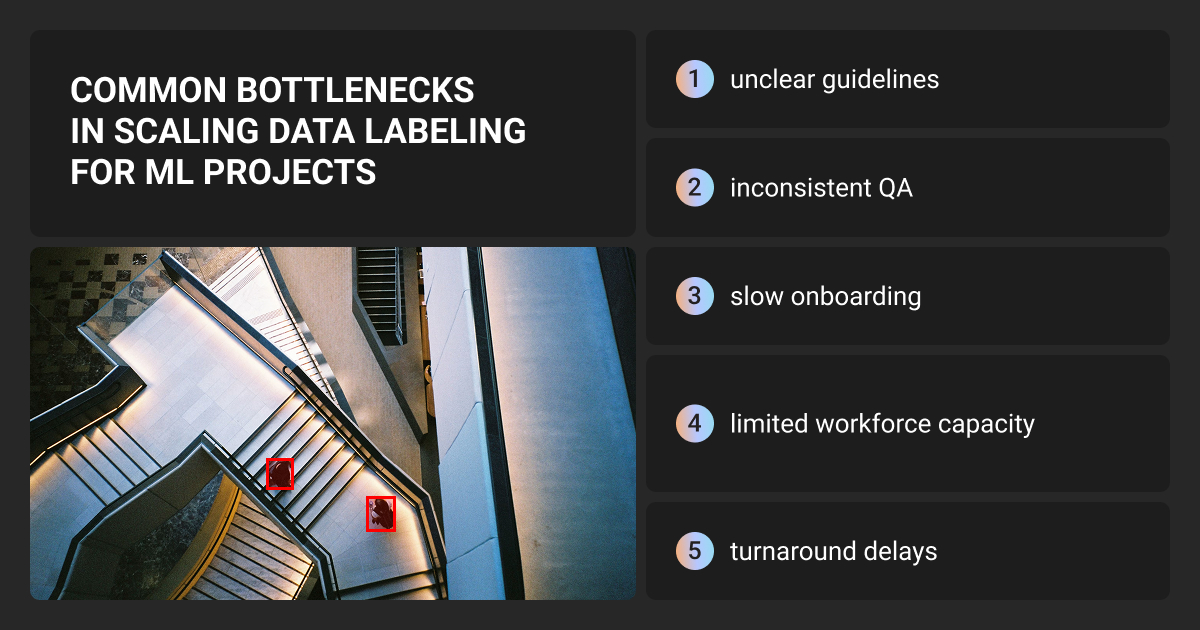
Before a pilot, Label Your Data asks for representative data, initial annotation instructions, known edge cases, and access to the client’s data annotation tools where needed. Your ML engineers, data scientists, or other technical stakeholders provide the starting requirements. Our Solutions Specialist reviews the instructions against the sample data, raises questions, and helps refine the guidelines through the pilot. We also agree on expected volumes, timelines, quality targets, and acceptance criteria.
Our process covers five stages:
- Pilot or extended pilot. The Solutions Specialist leads the technical assessment, and the pilot tests the team’s understanding of the task, annotation quality, handling times, and QA requirements.
- Project kickoff. We prepare tooling and access, introduce the Account Manager and supporting team, resolve outstanding questions, and agree on milestones and reporting.
- Onboarding and training. The assigned team practices using the project’s guidelines, tools, and QA requirements, with feedback and further clarification where needed.
- Production ramp-up. Short sprints give you an opportunity to review early outputs while we address errors, clarify edge cases, and monitor productivity.
- Scaled production. We gradually expand volume and team capacity once quality is consistent and your team is satisfied with progress.
An extended pilot may establish a production-ready team and workflow, allowing a direct transition into production. For other projects, further training or a client review period may be needed before work continues.
Label Your Data is a trusted AI data partner that prepares datasets for machine learning through human-in-the-loop processes, ensuring complex, custom annotation guidelines are followed accurately at scale.
How Label Your Data puts custom guidelines into practice
A provider’s onboarding process is easier to assess through a project that requires precise, shared interpretation of labeling rules. For KAUST’s fish keypoint annotation project, our team used guidelines with edge-case examples, reference images, and a short demonstration video to support consistent placement of seven keypoints per fish.
Twenty annotators completed the labeling, while five senior QA reviewers corrected and approved the results. The project met the client’s 98%+ accuracy requirement within a one-month deadline. For teams evaluating a partner for complex computer vision annotation, this example shows how task-specific guidance and dedicated review supported delivery against agreed requirements.
The pilot with Label Your Data gives you a measured view of quality on your own guidelines before you commit to a full scope.
Keep QA findings connected to daily annotation
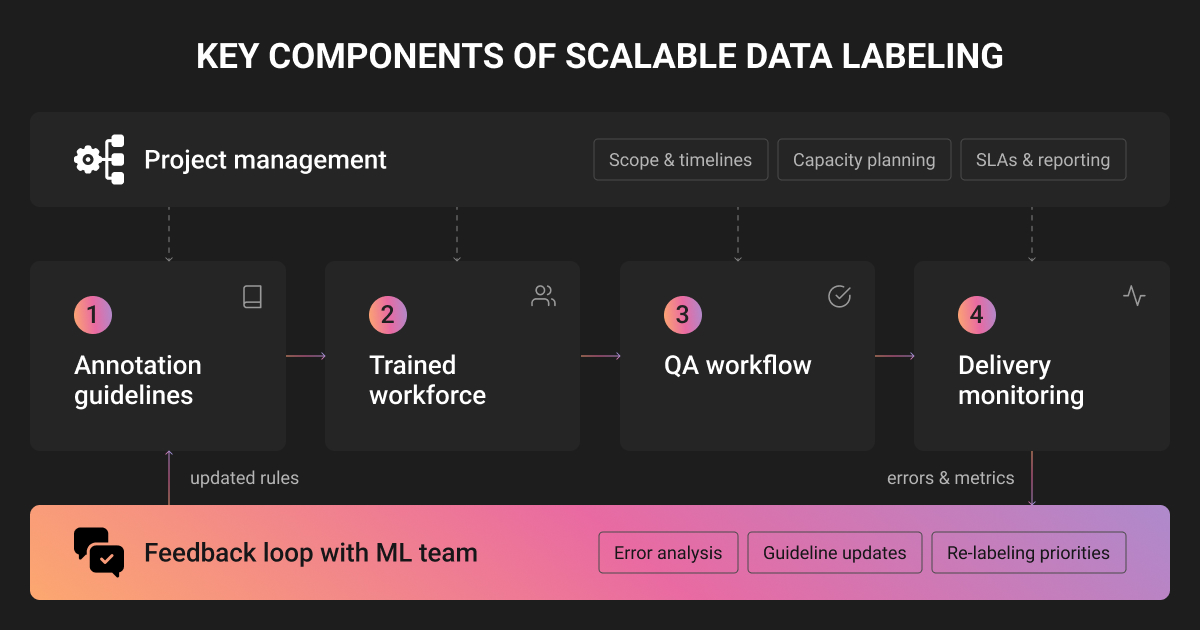
Annotation quality review should lead to changes in how the team works. If reviewers repeatedly find the same class confusion, a reliable annotation provider needs to determine whether the cause is an unclear definition, insufficient examples, or a training gap. Correcting individual labels without addressing that cause leaves the next batch exposed to the same error.
Scaling complex workflows requires a provider with robust operational processes for guideline updates and continuous feedback loops.
In annotation work, the bottleneck is validation at volume: labels keep arriving, but checking them takes longer than producing them, so errors found late mean rework across the whole dataset instead of a quarantined batch caught at intake.
 Software Development Engineer, Amazon
When evaluating any data labeling service for computer vision or any other complex ML project, establish who reviews recurring errors, who updates the instructions, and how the team checks whether the change worked. Those responsibilities require time and ownership, which belong in the comparison between managed delivery and running annotation internally.
Managed Annotation Services vs. Self-Managed Software
Self-managed annotation software gives your team control over tooling, but it also adds licensing, internal headcount, and quality assurance work. Tools can speed up labeling, and foundation models can pre-label data for human review. High-accuracy validation still usually depends on trained people reviewing the output.
📍 Can you evaluate the cost-benefit of using managed services versus self-managed annotation software for growing projects? Self-managed annotation software gives your team direct control, but its total cost includes licensing, staffing, training, QA, and coordination. Managed services can be more cost-effective as projects grow if they reduce recruitment, review, and rework costs while meeting the same quality requirements and deadlines. Compare both options using cost per accepted annotation and the internal oversight each requires. Label Your Data provides expert-led labeling and QA within clients’ preferred tools, allowing teams to delegate annotation operations while retaining responsibility for requirements and final acceptance. |
Weigh the strategic trade-offs between internal tooling and outsourced expert-led services by comparing the total cost of meeting your quality requirements and deadlines, including software, staffing, training, QA, and coordination. Internal management gives your team direct control but requires capacity to run the workflow, while outsourcing transfers labeling and review to a provider that can work within your existing tools.
Compare the full cost of delivery
A software subscription and a managed-service quote cover different things. Before comparing data annotation pricing of a managed service provider, establish which responsibilities and costs each option includes.
Include these costs when comparing proposals with internal delivery:
- Software licensing, hosting, maintenance, and model inference
- Recruitment, onboarding, annotation, and ongoing training
- QA, corrections, and repeat reviews
- Coordination, data preparation, integration, and final acceptance
Use the same workload and quality threshold for both estimates. A practical measure is total delivery cost divided by the number of accepted annotation units over the same period. Include the cost of rework, even when the corrected annotations eventually pass review. Avoid counting a cost separately if it’s already included in the provider’s fee.
Include coverage requirements in the cost comparison, especially if annotation requests span time zones or require weekend delivery. Label Your Data’s distributed annotation teams across regions help keep projects moving beyond standard working hours, with annotation, review, and coordination coverage agreed around your delivery needs.
Measure automation after review and correction
Automation can support both managed and self-managed annotation. Foundation models can generate pre-labels for human reviewers to check, correct, or send back for further work before the annotations are accepted.
The relevant saving is the work removed from the complete workflow. For example, pre-labels may reduce the time spent drawing bounding boxes, while human reviewers still need to find missed objects, correct classes, and apply project-specific occlusion rules.
While tools can accelerate operations, human expertise is often required for high-accuracy validation to interpret custom rules or resolve ambiguous examples.
After running pilots with several annotation providers, a Geberit Senior ML Engineer, Maxime Debarbat, reported that Label Your Data delivered the strongest results by a clear margin.
Decide which responsibilities your team can sustain
Internal management can fit a team that has trained annotators, sufficient reviewer capacity, and people available to maintain the workflow. Managed delivery becomes relevant when recruiting, training, QA, or coordination prevents the team from meeting its data requirements.
Compare how each option divides the work between your team and the provider as annotation volume grows.
| What matters as projects grow | Self-managed annotation | Managed annotation services |
| Adding capacity | Your team recruits, trains, and schedules additional annotators and reviewers. | ✓ The provider manages staffing and training against an agreed ramp plan. |
| Maintaining quality | Your team runs QA, investigates errors, and checks corrections. | ✓ The provider handles agreed review and correction processes against your acceptance criteria. |
| Updating complex guidelines | Your team documents decisions and trains everyone affected. | ✓ The provider incorporates agreed clarifications into working instructions and team training. |
| Managing delivery | Your team assigns tasks, tracks progress, and resolves bottlenecks. | ✓ The provider coordinates annotation delivery, reducing routine management work for your team. |
| Using existing tools | Your team controls the platform and workflow. | ✓ A tool-agnostic provider can work within your existing platform, reducing migration work. |
| Retaining technical oversight | Your team owns both annotation operations and domain decisions. | ✓ Your team focuses on data requirements, domain questions, and final acceptance while the provider runs labeling and review. |
Label Your Data provides expert-led data labeling services that allow teams to transition from self-managed software to managed workflows when project complexity or volume exceeds internal capacity. Our flexible and agile team works within your preferred annotation tooling and workflows. Your team defines the model’s data needs, approves acceptance criteria, and resolves domain decisions.
Use the pilot to compare both the annotations delivered and the work your team still has to do. That gives you a basis for deciding whether managed delivery can support your development schedule at an acceptable total cost. Run a no-cost pilot with Label Your Data to validate our quality on your own data before scaling annotation volume.
Consider the total cost of ownership, including tool licensing, internal headcount, and quality assurance, when deciding how to choose between managed services and self-managed software.
About Label Your Data
Label Your Data is a specialist AI data partner that provides transparent, tool-agnostic, human-in-the-loop annotation services designed to scale complex machine learning projects without sacrificing quality. Run a no-cost pilot to validate our quality on your own computer vision data before scaling.
 Data Annotation for Complex Environments
Rely on consistent, high-quality output for complex datasets, detailed taxonomies, and edge cases.
 Structured Quality From Pilot to Production
Get quality engineered into every step through onboarding, evolving guidelines, QA, and continuous feedback.
 Flexible and Scalable Operations
Adjust team capacity, project size, and delivery model as you scale, with no setup fees or long-term lock-ins.
 An Integrated Delivery Partner
Align on goals, workflows, and expectations with a team that integrates into your process from day one.
 Projects Led by Annotation Experts
Work with former annotators who understand annotation complexity, quality standards, and high-volume delivery.
FAQ
How to approach large-scale data labeling for computer vision?
- Start with a representative pilot, then scale annotation and review capacity against measured quality and delivery targets.
- Define the annotation unit, task complexity, acceptance criteria, and who resolves domain questions before production.
- Use pilot results to estimate staffing, review time, rework, and costs. Increase volume gradually while monitoring accepted output and review backlogs.
How to label a million images per day to train an ML model for visual recognition?
- Validate feasibility through a pilot that measures accepted annotations per day, including review and corrections.
- Define the image recognition task before estimating capacity. One category per image requires far less work than multiple detailed masks; even 10 seconds per image adds up to roughly 2,778 labor hours per million images.
- Test model-assisted labeling and the full delivery pipeline at increasing volumes. Confirm that annotation, review, infrastructure, and exports can sustain the target without growing backlogs.
What are the ways to scale data for a machine learning algorithm?
You can expand a training dataset for a machine learning algorithm through targeted collection, selective annotation, data augmentation, and validated synthetic or model-generated data. Use model errors to identify missing examples and prioritize what to label next. Keep augmentations realistic, update spatial labels when images change, and evaluate synthetic or automatically labeled data against independently labeled real examples before using it more widely.
How to make sure a large volume of data labeled by the annotator is correct?
- Combine task-specific acceptance criteria, automated checks, and human review rather than relying on one overall accuracy score.
- Compare labels against expert-reviewed reference examples. Check missed objects, class errors, and spatial accuracy separately, alongside structural issues such as invalid coordinates or missing attributes.
- Combine random sampling with targeted review of difficult cases and new annotators. Track recurring errors, address their cause, and verify corrections before accepting affected batches; sampling alone cannot guarantee every label is correct.
Written by
CEO of Label Your Data
Karyna is the CEO of Label Your Data, a company specializing in data labeling solutions for machine learning projects. With a strong background in machine learning, she frequently collaborates with editors to share her expertise through articles, whitepapers, and presentations.