


 Back to blog
Annotation Guidelines: Best Practices for ML Teams

 CEO of Label Your Data


Table of Contents


TL;DR
- Data annotation guidelines act as a decision-making framework and should not merely be viewed as a collection of classes and definitions.
- To create unambiguous instructions, you must define what counts, what doesn’t, where class boundaries sit, and what annotators should do when the data falls outside the rules.
- Testing annotation guidelines against real sample data helps prevent edge cases that only appear once your annotation team or a third-party vendor start applying the rules.
- Update the guidelines as new cases arise so that annotators, QA, and new team members are aligned with the same decisions.
If your data annotation guidelines cover only objects, classes, labels, and a few examples, you’re leaving too many decisions to the annotation team. Real project data will expose ambiguous boundaries, occlusion, overlapping classes, unclear context, and other edge cases the team needs clear rules for before annotation begins.
The more of those decisions you resolve upfront, the less room there is for inconsistent labels, QA disputes, and rework later.
Our team spent more than six years working on data annotation projects at Label Your Data where detailed taxonomies and edge cases directly affect output consistency. We’ve learned that an annotation guide becomes useful only after reviewing the instructions against real sample data, challenging vague rules, and turning unclear scenarios into decisions the team can apply consistently.
Here’s how to prepare team-ready annotation guidelines that help produce a dataset ready for model training.
Defining Annotation Rules for an Outsourced Team
As a data annotation outsourcing company, we require more than class definitions when reviewing a client’s annotation rules. Label Your Data works as an extension of your team, but we don’t share the implicit project knowledge of the ML engineers who created the instructions.
We therefore work with your technical stakeholders to refine and operationalize the existing guidelines, turning project knowledge into clear rules the annotation team can apply consistently.
For each class or annotation type, the guidelines should answer these questions:
- Which objects or scenarios qualify for each class?
- Which lookalikes or edge cases should be excluded?
- How much of an object must be visible to annotate it?
- Can one object receive multiple classes or labels?
- What exactly marks the start and end of an action or event?
- Which attributes are required for every annotation?
For example, “label damaged road surfaces” still leaves several decisions open. Does discoloration count? What about a repaired crack? How large does the defect need to be? Should the team label only the visible damaged area or the full affected section?
We saw this complexity firsthand in a pavement crack detection project, where our team annotated 10,000 images across 22 defect classes, with some frames containing more than 100 cracks and reduced visibility from rain or snow. This level of variation requires precise class definitions and boundary annotation rules.
The same computer vision problems during annotation appear across NLP projects. A class such as “negative sentiment” needs rules for sarcasm, mixed sentiment, quotations, and comments that contain several targets.
Team-ready rules replace individual interpretation with clear, project-wide decisions.

So much of the quality of annotation guidelines comes down to how well they eliminate ambiguity. Overlapping, loosely defined, or vague labels lead annotators to interpret the rules differently, creating inconsistencies that diminish model performance and are expensive to fix later. In one legal annotation project, adding explicit definitions, inclusion and exclusion rules, and side-by-side examples for borderline categories increased inter-annotator agreement from ~0.7 to 0.9.

 Co-founder, Enhancv
Last but not least, your data annotation guidelines should also define what not to annotate. Exclusion rules often matter as much as inclusion rules because they prevent the team from expanding the class beyond the data the model actually needs.
How to Build Team-Ready Data Annotation Guidelines
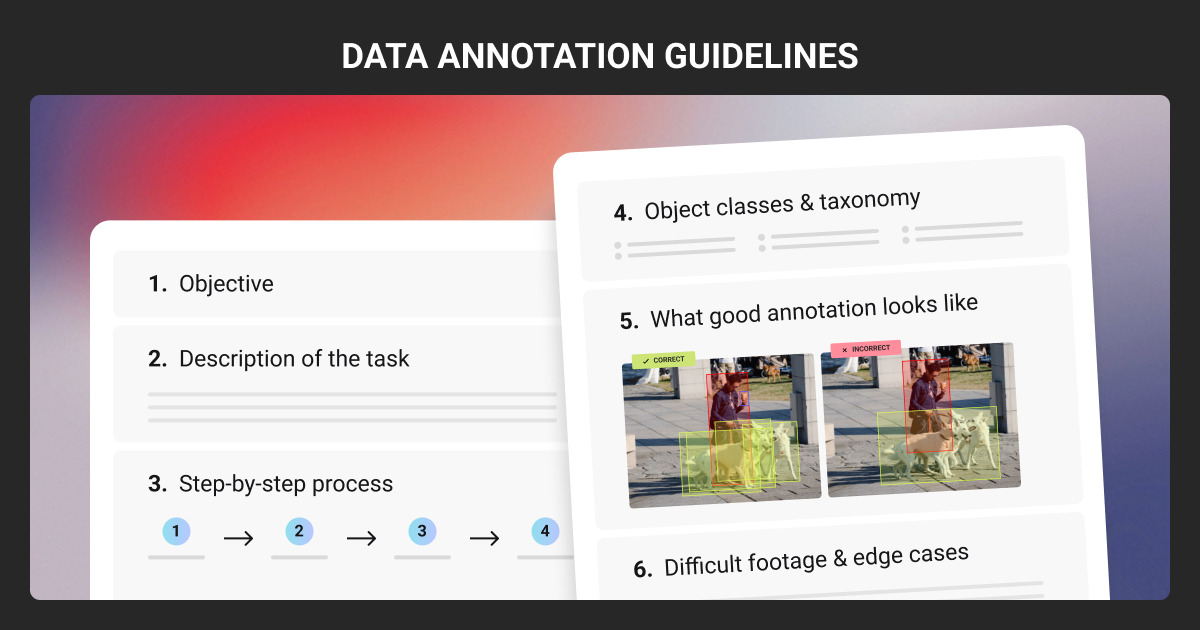
Practical instructions should give your annotation team or an outsourced one enough context, rules, and examples to perform the task without relying on undocumented project knowledge.
A useful structure covers the objective, task, workflow, taxonomy, expected output, and difficult cases before annotation begins.
1. Define the objective
Explain what information the annotated dataset needs to capture and how those labels will support the machine learning algorithm you’re training.
Keep this specific to the annotation objective rather than describing the entire AI product. For example, a pedestrian-detection task for an autonomous vehicle data annotation project should state whether the dataset needs every visible person, only specific road users, or another project-defined subset.
The objective gives context to decisions that individual class definitions can’t explain. Our data annotation guidelines framework at Label Your Data similarly starts by defining the task objective, the data being annotated, the expected annotation output, and how specific and consistent that output needs to be.
2. Describe the annotation task
Define exactly what the team receives and what it needs to return.
For an image recognition project, for example, you should specify which objects require masks, what portion of an occluded object should be annotated, which attributes are required, and how precise the boundaries need to be.
Similarly for a video annotation project, you need to clarify whether the team receives predefined clips or needs to identify the start and end of each action before describing it. That distinction changes the task itself and should never depend on assumptions.
3. Document the step-by-step process
If the annotation task includes several dependent stages, define the order in which they should happen.
The same video annotation workflow might require the team to review the full sequence for context, identify action boundaries, create action-level annotations, assign the required attributes, and flag unresolved cases.
The image annotation guidelines could instead require identifying eligible objects, drawing the required geometry, assigning the class and attributes, and checking whether any exclusion rule applies.
The goal isn’t to document every click in the data annotation tool. The process should clarify the steps where one decision affects the next one.
4. Define classes and taxonomy
List the approved classes, attributes, terms, and distinctions the annotation team needs to use consistently.
Avoid broad terms when the project requires a more specific distinction. If the label taxonomy distinguishes several types of equipment, road users, defects, or actions, define when each term applies rather than leaving the choice to individual judgment.
Preferred terminology also matters in data annotation, where two or more annotators can describe the same object or action with different words even when they understand the scene correctly.
5. Show what good annotation looks like
Correct examples show what the annotation should look like, while incorrect examples show what the team should avoid. Borderline examples are even more useful because they explain how the rule applies when the decision isn’t obvious.
Don’t include a screenshot or completed annotation without explaining the rule behind it. If an object should be excluded, state why. If a video segment ends on a particular frame, explain what observable change marks the end of the action.
This makes each example a reusable reference for similar annotation decisions instead of an isolated or unresolved case.
6. Cover complex data and edge cases
Data annotation guidelines should also explain what the team should do when the data doesn’t support an obvious decision.
Depending on the ML project, this could include heavy occlusion, unclear object identity, overlapping classes, poor image quality, incomplete actions, ambiguous text, or uncertain event boundaries.
When reviewing annotation instructions from our clients, we make sure to define when the team should follow an existing rule for a similar case, mark low confidence, skip an item if the project allows it, or flag the case for clarification.
The same rule should apply to unsupported inference. If the task asks for observable information, the annotation shouldn’t add intent or hidden context that the source data doesn’t provide. When the task relies on observable evidence, the text or image annotation guidelines should define what the data must show for a label to apply rather than leave the team to infer intent or missing context.
Refining Annotation Guidelines Around Edge Cases
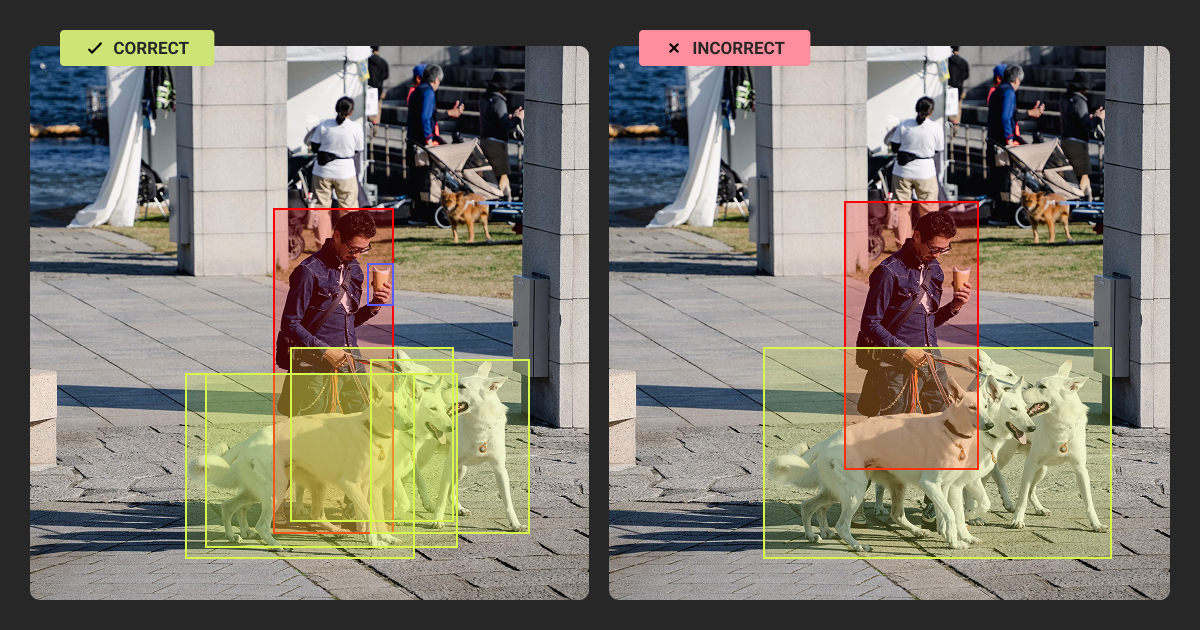
You can identify some problems by reading the annotation guidelines, but missing rules only become visible once you apply them to real sample data.
Pre-production review is one of the most useful ways to test whether the instructions are ready for a larger annotation team.
Apply annotation guidelines to real data samples
Use examples that represent the actual dataset rather than a small set of clean, obvious cases.
In computer vision, this could include partial occlusion, small objects, uncommon viewpoints, overlapping classes, truncated instances, or unclear boundaries. For NLP projects, test mixed sentiment, sarcasm, incomplete context, and examples that could reasonably fit several classes.
Identify the gaps behind disagreements
During the guideline review, test whether two annotators could follow the same rule and still reach different reasonable answers. If they can, your annotation guidelines may be missing an exclusion, a class boundary, a visibility threshold, an event boundary, or another project-specific decision.
If the same annotation rules lead to different reasonable answers, the problem may be the guidelines, not the annotators.
Some gaps are visible during the initial guideline review, but others only surface once we apply the instructions to real examples during the pilot. This is where unclear class boundaries, missing exclusions, subjective decisions, and edge cases become easier to identify and resolve before production scales.
Turn each clarification into an annotation rule
Each resolved question should become a clear rule in the data annotation guidelines, so your in-house or outsourced team can handle similar cases consistently later.
| Initial instruction | What is still unclear? | Refined rule |
| Label all vehicles. | Do bicycles, toy vehicles, reflections, or heavily occluded vehicles count? | Define the included vehicle classes, list explicit exclusions, and set the project rule for minimum visibility. |
| Create a segment for each action. | Does a pause create a new segment? What happens when the target object changes? | Define which changes start a new action and which remain part of the same continuous action. |
| Label negative comments. | How should sarcasm, mixed sentiment, or quoted speech be handled? | Define the sentiment target, rules for mixed cases, and when the team should flag insufficient context. |
The refined annotation guidelines example is stronger because it removes decisions that annotators would otherwise make independently.
When clients share existing project instructions and sample data, our team reviews how those rules work on real examples, flags unclear scenarios, and works with the client’s technical stakeholders to refine the annotation guidelines. The no-cost pilot then validates both our ability to perform the task and whether the instructions are detailed enough for consistent production.
Useful annotation guidelines begin with a clear labeling ontology and acceptance criteria that state what a label means, what it does not mean, and what good looks like with examples. The most overlooked detail is ambiguity around borderline classes and scenarios, because it drives rework and can seriously harm model quality later. Concrete examples of acceptable and unacceptable labels, together with a clear escalation path, help maintain consistency.
 AI & Data Platform Leader
Decisions such as whether the team must segment video before labeling can affect annotation time, QA effort, throughput, and data annotation pricing.
Data Annotation Guidelines Handoff and Feedback Loop
The refined machine learning data annotation guidelines should become the shared reference for annotation training and cross-reference quality check (aka QA), not merely a document that gets approved once and then stops changing.
During annotation team training, we focus on applying the refined annotation rules to representative and borderline examples rather than memorizing class names. This helps us understand whether different team members interpret the same rule in the same way before production volumes increase.
After the annotation stage, our QA specialists use those same annotation guidelines as acceptance criteria. If the instructions define how to handle partial visibility, segmentation boundaries, class overlap, or required attributes, quality reviewers can evaluate the output against the same documented decisions.
New edge cases will still appear once the team starts working through a broader dataset. When that happens, we suggest checking whether existing instructions already cover the scenario. If they don’t, you must clarify the expected decision and add it to the working guidelines so the same question doesn’t need to be solved repeatedly.
This is especially important as annotation teams grow. At Label Your Data, client projects often scale over time, so our data annotation services need to stay flexible while keeping the same annotation rules and quality standards across a larger team.
If a major rule changes during production, also check whether previously annotated data follows the updated interpretation. Applying a new rule only to future batches can create inconsistency inside the same training machine learning dataset.
Ready-to-Use Annotation Guidelines Checklist
Use this blueprint to check whether your annotation guidelines give the team enough information to deliver consistent, high-quality training data.
| Add to your guidelines | What you need to define | Questions to answer upfront |
| Annotation objective | What the labeled data needs to capture and what the annotation output represents. | • What exactly are we asking the team to identify, classify, segment, describe, or track? • What information does the model need from each annotation? |
| Task description | The input data, annotation type, expected output, and required level of detail. | • Are we annotating images, video, text, audio, or 3D data? • What should each completed annotation contain? • What parts of the task are the annotation team responsible for? |
| Step-by-step process | The order in which the team should complete dependent annotation steps. | • Does the team need to review context first? • Should segmentation happen before classification or description? • When should attributes or metadata be added? |
| Classes and taxonomy | Approved classes, attributes, terminology, and distinctions between similar labels. | • What qualifies for each class? • Which terms should the team use consistently? • How do we distinguish classes that could overlap? |
| Annotation rules and boundaries | Inclusion, exclusion, geometry, visibility, segmentation, and multi-label rules. | • What should be excluded? • How much of an object must be visible? • Should annotators label visible or inferred boundaries? • When does one action end and another begin? |
| Correct, incorrect, and borderline examples | Real examples that demonstrate how each important rule should be applied. | • What does an accepted annotation look like? • Which similar-looking case should be rejected? • Which borderline cases are most likely to cause disagreement? |
| Edge-case handling | What the team should do when the current rules don’t produce a clear answer. | • Should the case be annotated, skipped, marked low confidence, or flagged for clarification? • Which existing rule applies to similar cases? |
| QA criteria | The conditions reviewers use to accept or return an annotation. | • Which errors require correction? • Which attributes are mandatory? • How much boundary variation is acceptable for this task? |
| Guideline updates | How new clarifications and recurring edge cases become part of the working instructions. | • Has a new decision changed an existing rule? • Does the guide need another example? • Do earlier annotations need review after a major rule change? |
If the answer to any of these questions still depends on individual judgment, test that rule against sample data and resolve the ambiguity before annotation scales.
About Label Your Data
If you need expert support with annotation guidelines prep before scaling your project, talk to our team at Label Your Data. Our outsourcing strategy has helped many companies scale their ML projects. Here's why:
 Data Annotation for Complex Environments
Rely on consistent, high-quality output for complex datasets, detailed taxonomies, and edge cases.
 Structured Quality From Pilot to Production
Get quality engineered into every step through onboarding, evolving guidelines, QA, and continuous feedback.
 Flexible and Scalable Operations
Adjust team capacity, project size, and delivery model as you scale, with no setup fees or long-term lock-ins.
 An Integrated Delivery Partner
Align on goals, workflows, and expectations with a team that integrates into your process from day one.
 Projects Led by Annotation Experts
Work with former annotators who understand annotation complexity, quality standards, and high-volume delivery.
FAQ
Can you help us create or refine our annotation guidelines?
Most Label Your Data clients come to us with at least a basic set of instructions prepared by their ML engineers, data scientists, or other technical stakeholders. We help refine and operationalize those guidelines by testing them against sample data, identifying missing rules and edge cases, and turning clarifications into instructions the annotation team can apply consistently.
If your annotation guidelines are still at an early stage, we can also help build them out with your technical team so the annotated dataset aligns with your project requirements and model training needs.
What is an example of a good annotation?
A good annotation follows the task’s required level of specificity and uses the approved taxonomy. For a video action task, for example, “picks up the red-handled screwdriver from the workbench” provides clearer observable information than “takes the tool.”
Are there rules to annotating?
Yes, annotation rules are project-specific instructions that define what to label, what to exclude, how to draw or structure the annotation, how to handle ambiguous data, and what QA should accept.
How do I write an annotation?
Follow the project schema and describe only the information the task requires. Use the approved class names or terminology, apply the defined boundaries, and flag cases where the available data doesn’t support a confident decision.
How do I annotate a guide?
If you mean how to create an annotation guide, document the task objective, taxonomy, annotation rules, inclusion and exclusion criteria, examples, edge-case handling, and QA requirements. Then test those instructions against real sample data before scaling.
Written by
CEO of Label Your Data
Karyna is the CEO of Label Your Data, a company specializing in data labeling solutions for machine learning projects. With a strong background in machine learning, she frequently collaborates with editors to share her expertise through articles, whitepapers, and presentations.