


 Back to blog
Social Media Dataset: Preparation for ML Training

 CEO of Label Your Data


Table of Contents


TL;DR
- Social media data includes posts, comments, images, videos, interactions, timestamps, and account relationships that can support different ML tasks.
- Choose social media datasets based on the model task, data rights, platform coverage, metadata, and how current the data is.
- Structure the dataset around the right unit of analysis, such as a post, thread, session, or account, and preserve the context the model needs.
- Build clear annotation guidelines, test them on difficult cases, and use annotator disagreement to improve the labeling process before scaling.
- Before training, check label consistency, coverage, duplicates, data leakage, provenance, usage rights, and dataset versioning.
Social media data captures how people communicate, react, share opinions, and interact with content at scale. Posts, comments, images, videos, engagement signals, and conversation threads can all provide useful training data for machine learning models.
That makes social media datasets relevant for tasks such as content moderation, sentiment analysis, recommendation, trend detection, and behavior modeling. But raw platform data is rarely ready for training. It needs to be sourced carefully, structured around the model task, cleaned, and often annotated before it becomes useful.
This article explains where to get social media data, how to structure and annotate it, and what to check before using a social media dataset for AI training and evaluation.
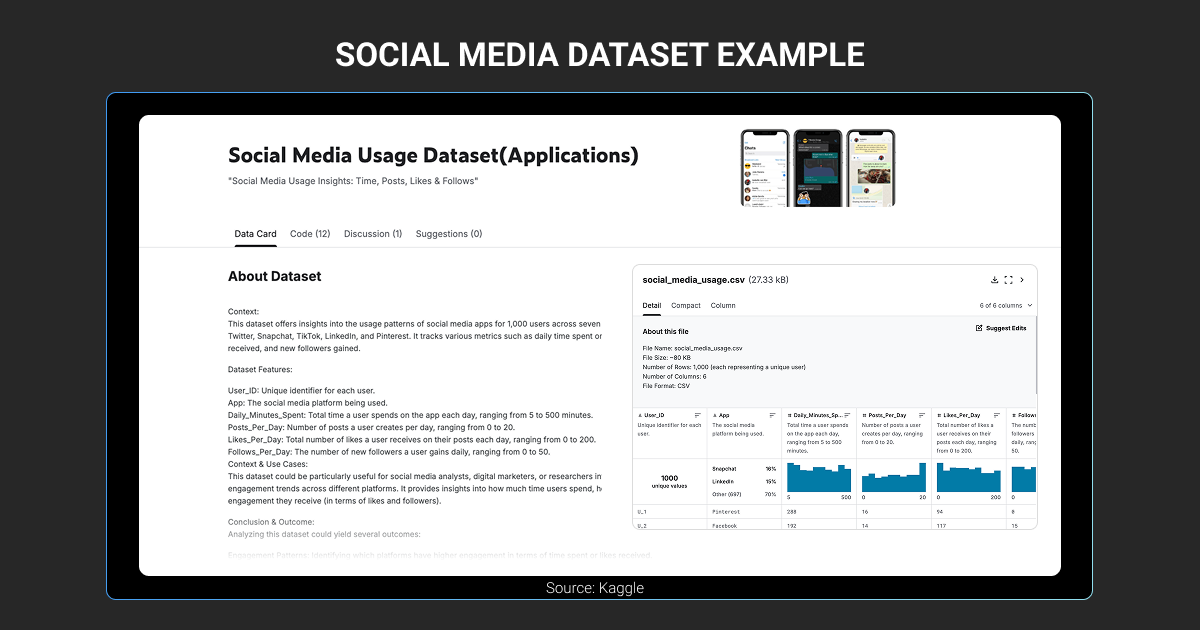
Types of Social Media Data for ML Models
Social media datasets can combine content with the behavioral and contextual signals around it. The useful data types depend on what your machine learning algorithm needs to learn.
| Data type | Examples |
| Text | Posts, comments, captions, replies, hashtags |
| Images and video | UGC images, short videos, thumbnails, frames |
| Engagement and social media usage data | Likes, shares, clicks, views, watch time |
| Conversation and network data | Reply threads, follows, mentions, reposts |
| Metadata | Timestamps, post IDs, language, content format |
Data on social media usage can add behavioral context, such as how users view, share, or interact with content over time. These signals can be used separately or combined, depending on the ML task and the context the model needs.
Machine Learning Tasks Using Social Media Data
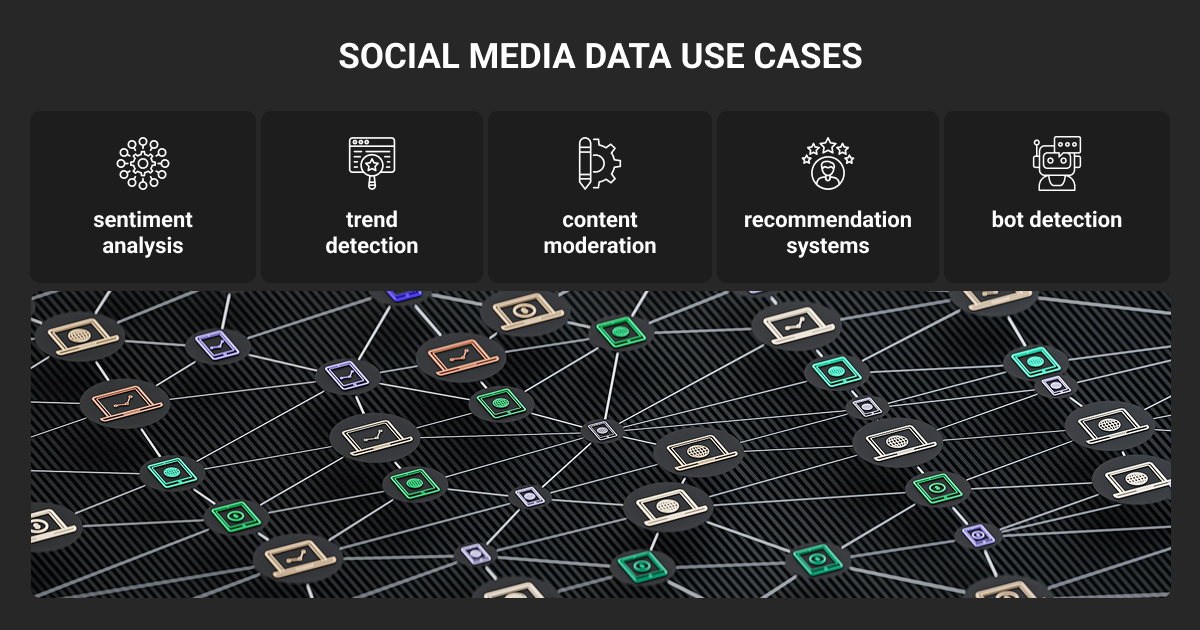
Social media data can support different ML tasks depending on the content, context, and behavioral signals available in the dataset.
UGC classification and content understanding
Models can classify user-generated content by topic, intent, category, or policy type. Depending on the task, the social media dataset may include text, images, video, or several formats together.
For visual UGC, image recognition models can classify images by content, objects, scenes, or other task-specific categories.
Content moderation and toxicity detection
Moderation models use labeled social media data to detect harassment, hate speech, threats, spam, and other policy violations. More detailed workflows may also include severity levels or escalation categories.
Recommendation and ranking
Recommendation models rely heavily on interaction data such as impressions, clicks, skips, watch time, likes, and repeat visits. Event order also matters because it shows how users respond to content over time.
Trend and topic detection
Trend detection models analyze how topics, hashtags, or content spread across accounts and time periods. Accurate timestamps and activity patterns help distinguish organic trends from sudden or coordinated spikes.
Bot detection and social graph analysis
Bot and network models focus on relationships between accounts, including follows, mentions, reposts, and reply patterns. These social media data signals can help detect coordinated behavior, fake accounts, or unusual activity patterns.
Sentiment analysis
Sentiment models classify opinions or emotions in posts and comments. Because sarcasm, slang, and context can affect meaning, high-quality social media sentiment analysis datasets usually require clear labeling rules and human review.
Where to Get Social Media Data: Key Sources
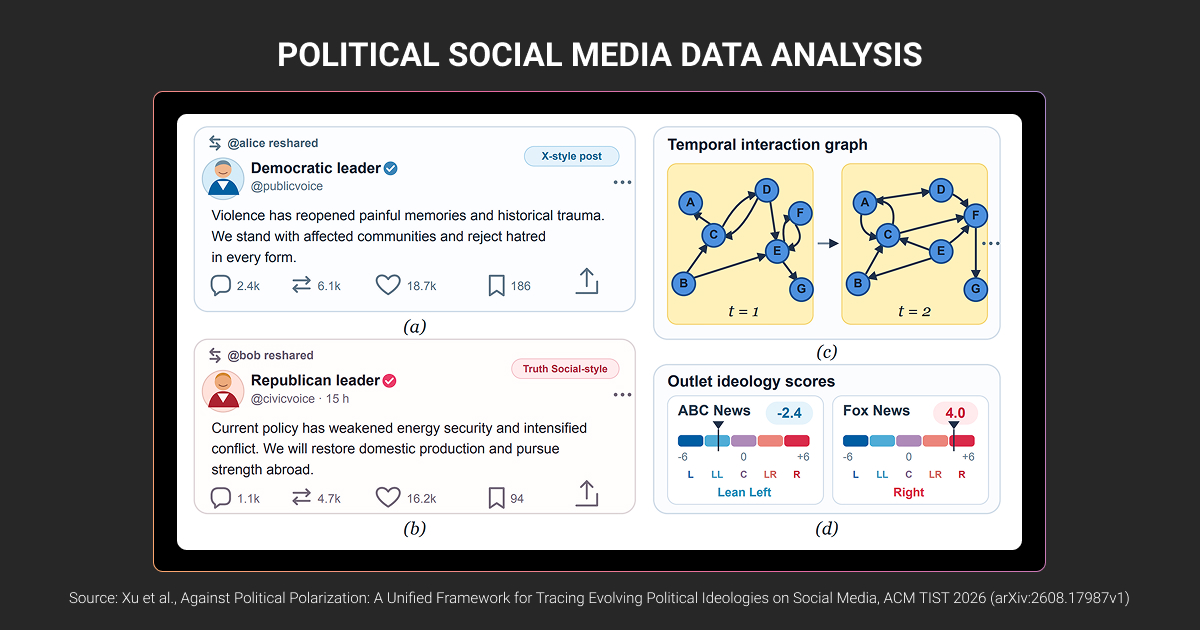
Social media data collection depends on two things: where the data comes from and how you access it. Different social media data sources can offer similar content but vary in coverage, metadata, freshness, licensing, and usage restrictions.
Social media data collection methods
Common social media data collection methods include official APIs, public datasets, licensed data access, and web scraping.
Top social media data APIs usually provide structured data and metadata, which reduces preprocessing work. Public social media datasets Kaggle, for example, can be useful for prototyping or benchmarking. Web scraping gives you more flexibility for social media data extraction when an API does not expose the fields or history you need.
Research repositories and public social media databases can provide ready-made data for experimentation. In each case, check platform terms, privacy requirements, rate limits, and data rights before using social media data collection tools or sourcing it manually.
Social media data providers
Social media data providers generally fall into two groups. First-party platforms, such as Reddit and YouTube, can provide direct API or licensed access to data from their own services. This can give you clearer provenance, current platform-specific metadata, and more control over what you collect.
Third-party providers aggregate this data from one or several social media data platforms and may offer historical data, normalized formats, filtering, or pre-built datasets. They can be useful when you need broader coverage or want to avoid building separate collection pipelines for each platform.
Before choosing a provider, compare platform coverage, available fields, collection dates, licensing terms, and whether the data matches your ML task.
Once the data is sourced, the next step is turning it into structured, labeled machine learning datasets. That’s where a data annotation company like Label Your Data can support annotation and QA for custom social media data sets.
How to Structure Social Media Data for ML
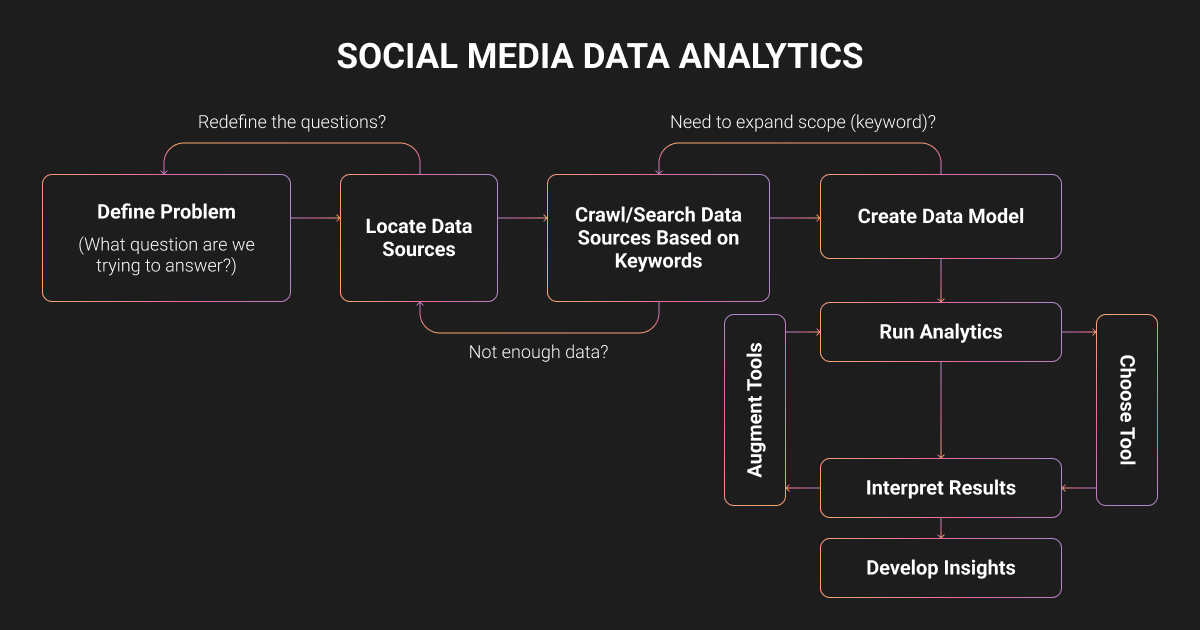
Once the data is collected, the next step is to structure it around the model task. Decide what one training example represents, which fields the model needs, and which relationships should remain intact during preprocessing.
Choose the right unit of analysis
Define what one training example represents before preprocessing. For a text classifier, this may be a single post or comment. A recommendation model may need a sequence of impressions and interactions from the same user session, while a conversation model may need an entire reply thread.
The unit of social media data analysis should stay consistent across preprocessing, data annotation, and dataset splitting.
Preserve context and social signals
Keep the context that affects the target label or prediction. This may include parent posts, reply order, timestamps, interaction types, session IDs, or account relationships useful for social media data tracking.
Store these signals in separate fields instead of mixing them into the content itself. Keep only the social media metadata that supports the model, annotation workflow, dataset split, or QA process.
Prevent leakage across dataset splits
Related examples should not appear across training and test datasets when they share information the model could memorize. This can happen with replies from the same thread, duplicate reposts, repeated content from one account, or events from the same session.
Group related records by thread, account, session, campaign, or time period before splitting the social media dataset. Then check for exact and near-duplicate content across splits.
How to Annotate Social Media Datasets for AI
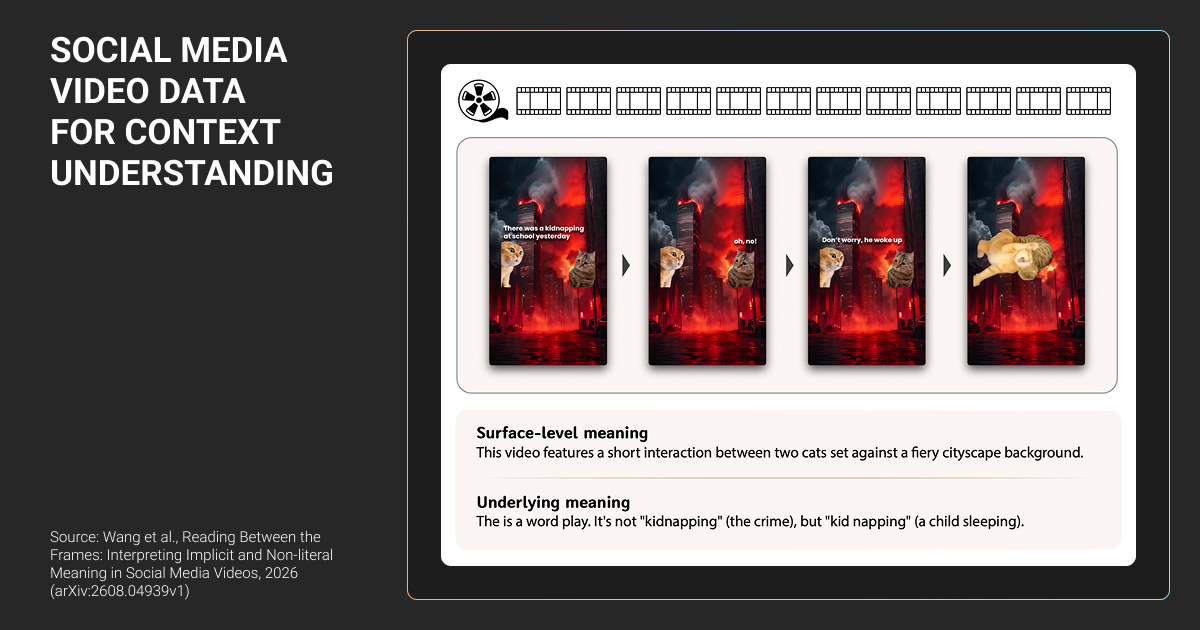
Annotating social media datasets means adding labels that match what the model needs to predict.
Because social content often includes sarcasm, slang, mixed intent, and missing context, the workflow needs clear guidelines, quality checks, and a process that can scale with the dataset.
Create annotation guidelines
Start with clear label definitions and examples of difficult cases. For sentiment analysis, a comment such as “great, another delay” may look positive without context but is clearly negative in the full thread.
Define how annotators should handle sarcasm, mixed sentiment, emojis, ambiguous wording, and context-dependent replies. If the same cases repeatedly cause disagreement, refine the annotation guidelines before scaling the project.
Choose the right annotation setup
Decide whether your team will manage annotation in-house or work with a third-party data annotation provider.
An internal team gives you direct control over the workflow but also requires recruiting, training, QA, tooling, project management, and data annotation tools. Managed data annotation services can handle the workforce, annotation process, and quality control for teams that do not want to build those operations internally.
When comparing the two approaches, consider data annotation pricing alongside QA requirements, turnaround time, annotation complexity, and expected data volumes.
Run a pilot and scale annotation
Start with a small batch that includes difficult and representative examples. Review social media data annotation quality, measure disagreement, and update the guidelines before moving into full production.
As data volumes grow or new edge cases appear, continue reviewing the taxonomy and QA rules. This helps keep labels consistent as the social media dataset and model requirements evolve.
What Makes a Social Media Dataset Training-Ready
A social media dataset is ready for AI model training when its labels, context, coverage, and data splits match the model task. Having every row labeled is not enough.
| Check | What to verify |
| Label consistency | Annotators follow the same taxonomy and unclear cases have a defined review process. |
| Context | Threads, timestamps, sessions, or interaction history are preserved when they affect the target. |
| Coverage | Key classes, languages, platforms, behaviors, and edge cases are represented. |
| Duplicates | Exact and near-duplicate content is removed or controlled. |
| Data splits | Related threads, accounts, sessions, or campaigns do not leak across train and test sets. |
| Data rights and provenance | Each source is traceable, permitted for the intended ML use case, and handled according to social media data security requirements. |
| Versioning | Label definitions and annotation guideline versions remain traceable across batches. |
Run these checks before moving the social media dataset into model training and evaluation.
If you outsource data annotation, choose a provider that can keep the taxonomy, QA rules, and edge-case decisions consistent as data volumes grow. At Label Your Data, we build these controls into managed annotation workflows from pilot to production.
About Label Your Data
If you choose to delegate social media data annotation, run a free data pilot with Label Your Data. Our outsourcing strategy has helped many companies scale their ML projects. Here’s why:
 Data Annotation for Complex Environments
Rely on consistent, high-quality output for complex datasets, detailed taxonomies, and edge cases.
 Structured Quality From Pilot to Production
Get quality engineered into every step through onboarding, evolving guidelines, QA, and continuous feedback.
 Flexible and Scalable Operations
Adjust team capacity, project size, and delivery model as you scale, with no setup fees or long-term lock-ins.
 An Integrated Delivery Partner
Align on goals, workflows, and expectations with a team that integrates into your process from day one.
 Projects Led by Annotation Experts
Work with former annotators who understand annotation complexity, quality standards, and high-volume delivery.
FAQ
What is a social media dataset?
A social media dataset is a collection of content, interactions, and metadata gathered from social media data platforms. It can include posts, comments, images, videos, likes, shares, reply threads, timestamps, and account relationships. For big data and social media analytics, the data must be structured around the model task and may also require annotation.
How to scrape social media data?
- Check whether the platform provides an official API before using a social media data extractor.
- Define the content, metadata, and relationships your model needs.
- Account for authentication, pagination, rate limits, and missing records.
- Remove duplicates and validate required fields before annotation or training.
- Review the platform’s current terms, privacy requirements, and permitted data uses.
How to analyze social media data?
- Define the ML task, such as sentiment analysis, content moderation, recommendation, or behavior analysis.
- Select the content, metadata, interaction signals, or network relationships relevant to that task.
- Preserve timestamps, threads, sessions, and account relationships when they affect the target.
- Structure and annotate the data using a consistent taxonomy.
- Evaluate results on held-out data and check for duplicate or related examples across dataset splits.
Do social media datasets need to be annotated for machine learning?
Not every social media dataset requires manual annotation. Models trained on supervised tasks such as sentiment analysis, content moderation, toxicity detection, or UGC classification typically need labeled examples.
The annotation should match the model’s target classes and preserve any context needed to make the correct decision. Custom annotation is especially useful when existing datasets use labels, policies, languages, or domains that do not match your production use case.
Written by
CEO of Label Your Data
Karyna is the CEO of Label Your Data, a company specializing in data labeling solutions for machine learning projects. With a strong background in machine learning, she frequently collaborates with editors to share her expertise through articles, whitepapers, and presentations.