








 Back to blog
AI Trainer: How to Hire and Evaluate for ML Projects

 CEO of Label Your Data


Table of Contents

- TL;DR
- Who Is an AI Trainer?
- What Does an AI Trainer Actually Do?
- Do You Need AI Trainers or ML Engineers?
- How to Hire AI Trainers: Skills and Signals to Look For
- How to Evaluate AI Trainers for Hire
- Common Pitfalls When Hiring AI Trainers
- In-House AI Trainer Team vs. a Managed Annotation Partner
- About Label Your Data
- FAQ

TL;DR
- AI trainer is an umbrella role covering data annotation, RLHF, and LLM evaluation across images, video, text, audio, and 3D sensor data, with skill requirements that vary sharply between modalities.
- Calibration trials on hidden gold-standard examples predict on-the-job quality better than resumes or interviews, and consistently low inter-annotator agreement is a rubric problem before it is a candidate problem.
- In-house teams suit stable, high-volume work where annotation is a competitive moat, while managed AI trainer partners ramp 2 to 3 times faster and flex with release cycles, which is why most CV and GenAI teams land on a hybrid model.
Labeled data and ranked model outputs do not produce themselves. Someone has to draw the cuboids, rank the responses, write the gold-standard answers, and flag the hallucinations.
That someone is an AI trainer. The title means five different things depending on who you ask, and the people you pick now will shape your model’s accuracy for months.
This guide covers what AI trainers actually do and how to hire and evaluate the right one for your ML project.
Who Is an AI Trainer?
An AI trainer is a human contributor who teaches machine learning models through labeled data and human feedback.
The role sits at the intersection of data annotation and reinforcement learning from human feedback (RLHF). Model evaluation work runs through both. Some companies use this title for annotators drawing bounding boxes on images. Others reserve it for senior subject matter experts (SMEs) ranking LLM responses.
In both cases, AI trainers produce the supervised signal your model learns from. And the work is scaling fast. Grand View Research puts the global data labeling market at $17.10B by 2030 at a 28.4% CAGR. The growth is driven largely by generative AI and RLHF pipelines.
What Does an AI Trainer Actually Do?
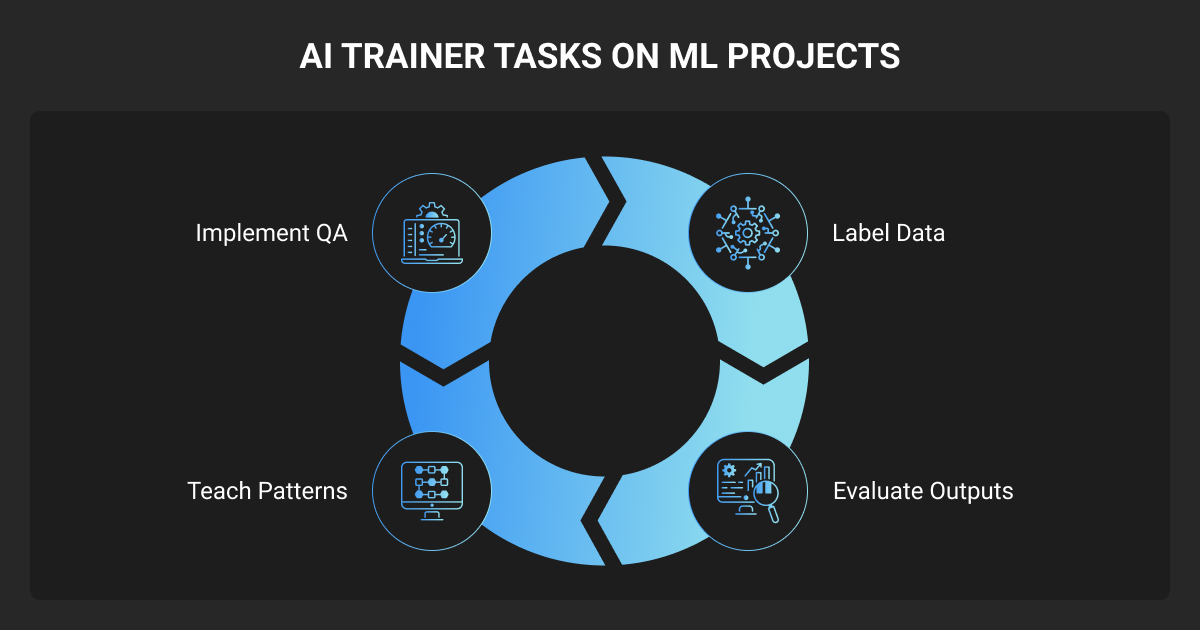
The work splits into three broad categories. Most production ML teams need a mix of them.
Data annotation
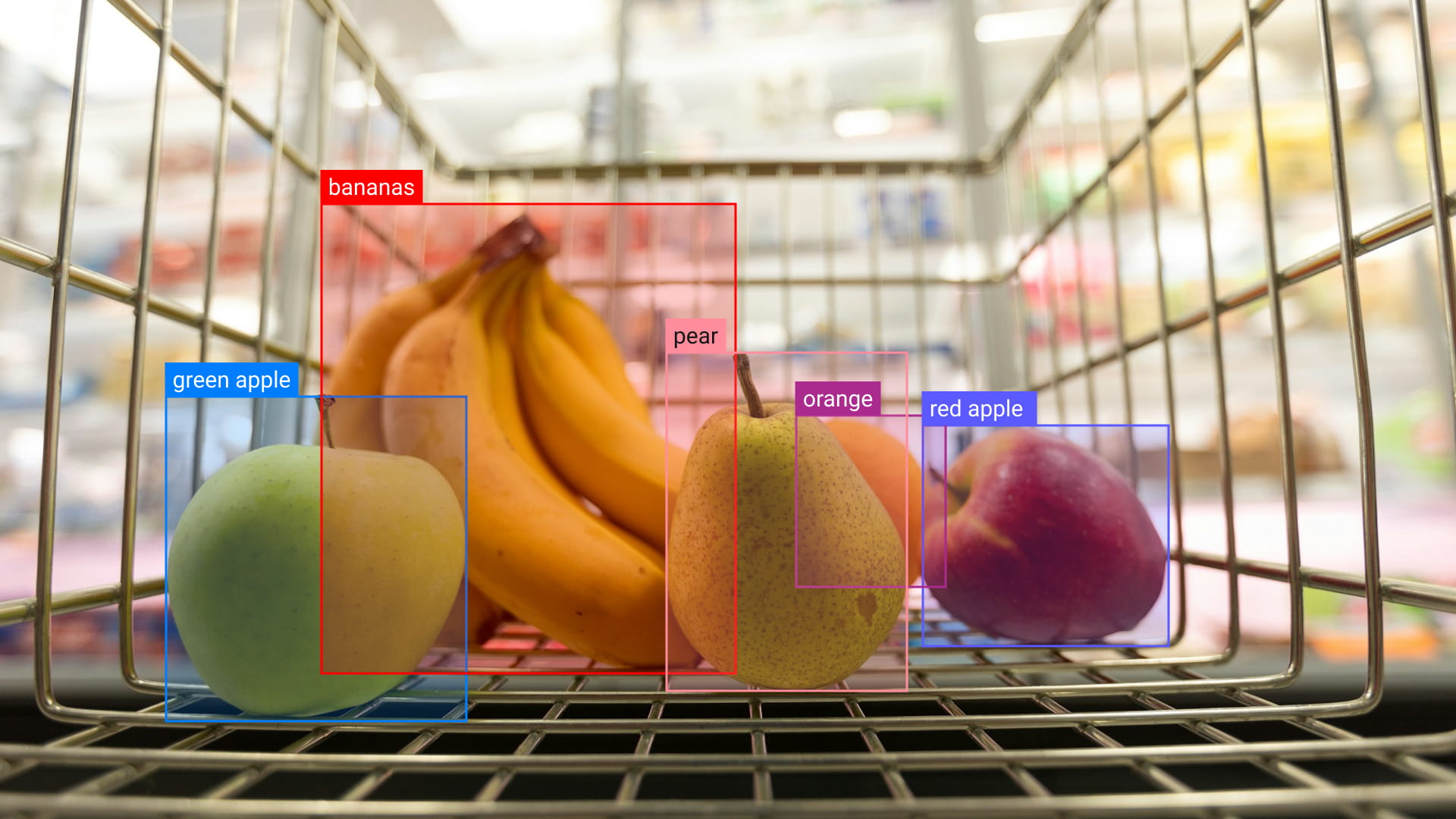
This is the foundation of every supervised model. AI trainers turn raw inputs into structured labels across images, video, text, audio, and 3D sensor data.
The work ranges from 3D cuboids on LiDAR scans and damage segmentation on insurance photos to named entity extraction in contracts and intent tagging in chatbot logs. Cognilytica research shows that around 80% of AI project effort goes into data preparation, and the majority of that effort is annotation.
RLHF and LLM evaluation
For generative models, AI trainers rank pairs of model outputs, score responses on helpfulness and harmlessness, write reference answers, and flag hallucinations.
RLHF annotators sit closer to SMEs than to traditional labelers. Generic crowdworkers cannot reliably judge whether a medical answer is safe or whether a legal summary is accurate. Second Talent reports that producing 600 high-quality RLHF annotations can cost around $60,000, roughly 167 times the compute expense for the same training run.
Prompt engineering and red-teaming
A growing slice of AI trainer work is creating the inputs themselves. This work includes writing adversarial prompts and designing evaluation rubrics. Some teams also use AI trainers to generate synthetic conversations for fine-tuning sets. Domain expertise matters the most here.
Do You Need AI Trainers or ML Engineers?
You need both, and the line is sharper than most teams realize.
ML engineers build the model architecture and training pipelines, including selecting the right machine learning algorithm for the problem. AI trainers produce the data those pipelines consume.
The common mistake is asking your engineers to annotate ML datasets themselves because hiring feels harder. We have seen this go wrong across the client projects at Label Your Data. ML engineers burn out on repetitive labeling. Quality stays low because nobody owns the rubric, and your most expensive headcount spends weeks on tasks an annotation team could finish in days.
The teams that ship faster put data work in the hands of people whose actual job is specialized data work.
Take Skylum’s photo-editing models, where our AI trainers labeled 70,000 detailed features across 22 categories, including scars, moles, and freckles that public datasets did not cover. That kind of specialized annotation work is what frees up engineers to focus on architecture.
How to Hire AI Trainers: Skills and Signals to Look For
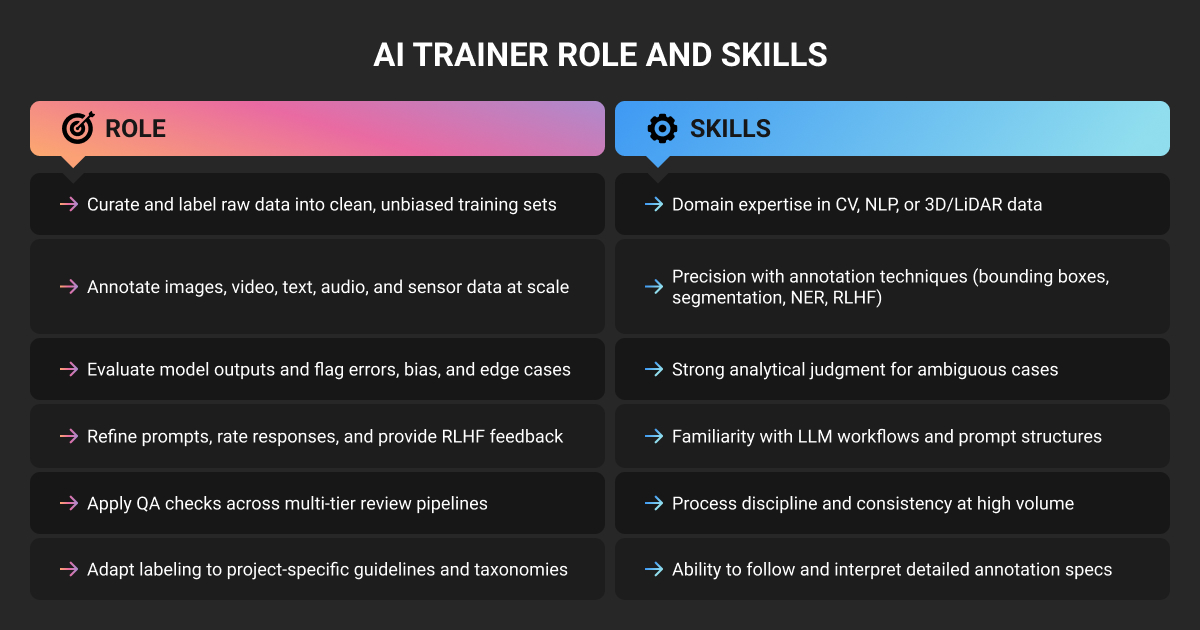
Strong AI trainers are defined by judgment under ambiguity and consistency across thousands of small decisions. Technical credentials matter less than you might assume.
For data annotation work, look for:
- Pattern recognition and attention to detail across high volumes
- Patience with repetitive tasks (the work demands it)
- Familiarity with major data annotation tools
- The ability to apply complex rubrics consistently across edge cases
For RLHF and LLM evaluation, look for:
- Genuine domain expertise in your field (and the one your model needs to understand)
- Strong written language skills and reading comprehension
- Calibrated judgment about safety and factuality
- Willingness to disagree with the model and explain why
Two qualities separate strong AI trainers from average ones: attention to edge cases and clear written rationale. The annotator who flags an ambiguous case and writes a one-sentence explanation saves your team hours of confusion downstream.

The most important thing to give your annotation team at the start is a clear guide for handling borderline cases. Roughly 10 to 20 percent of your examples are edge cases, and everyone handles them differently. The labels are inconsistent. A model can't learn "reasonable," it learns patterns, and inconsistent patterns turn your training data into a coin flip.

 Data Engineering Leader, Springpoint Technologies
How to Evaluate AI Trainers for Hire
Here is the evaluation sequence we run across our managed teams:
Calibration set
Hand candidates 50 to 100 examples with hidden gold-standard answers. Measure accuracy against your reference.
Inter-annotator agreement
Have 3-5 candidates label the same set. Annotators tend to disagree on 30 to 50% of subtle comparisons, so consistent agreement on your specific task is a strong signal.
Edge-case test
Include 10 deliberately ambiguous examples. Strong candidates flag them. Weaker candidates guess.
Throughput check
Measure pace alongside accuracy. A candidate who hits 95% accuracy at one-fifth the expected speed is not yet production-ready.
Written rationale
Ask candidates to explain three of their hardest decisions. This reveals whether they understand the rubric or are just pattern-matching.
The only reliable way to evaluate an AI trainer is to give them real labeling work and measure it. Resumes and interviews barely correlate with on-task quality.
Common Pitfalls When Hiring AI Trainers
After managing annotation teams for AI training across 200+ ML projects, we keep seeing the same four mistakes. Each one is recoverable but none of them is cheap.
- Hiring for throughput over judgment. Speed without accuracy creates noisy training data that hurts your model. Hire for the second skill first.
- Treating annotation as unskilled work. This is how you end up with 30% accuracy on edge cases and a reward model that learned the wrong things.
- Skipping the QA layer. A single-pass annotation workflow misses 5 to 15% of errors that a two-tier review would catch. For RLHF data, those errors compound through the reward model into the deployed system.
- Underspecified rubrics. Annotators cannot give you consistent labels for a rubric that reads “pick the best response.” Write criteria that map directly to your model's safety and quality goals.
A good rubric does more work than a great annotator. Invest in the document before you invest in the headcount.
The biggest mistake we made early on was not clearly defining success metrics upfront. We told our annotation team to label "good candidates" but didn't specify whether we prioritized safety, patient satisfaction, or conversion rates, and that created massive rework when annotations optimized for the wrong goal. From my research days at Hopkins, I learned that garbage data creates garbage models.
 President & CEO, ProMD Health
In-House AI Trainer Team vs. a Managed Annotation Partner
Building an in-house AI trainer team makes sense when annotation is a core competitive moat and you have the management bandwidth to run it. Yet, for most ML teams, a specialized data annotation provider delivers labeled data faster than internal headcount.
The honest trade-offs:
In-house teams give you tight control and direct access to annotators when rubrics evolve. The downside is that you carry recruiting, training, QA tooling, attrition, and management overhead.
A managed AI data partner like Label Your Data brings pre-trained, dedicated annotation teams that ramp on your project in days rather than months. You skip recruiting and onboarding, along with the QA infrastructure build. Here, success depends on strong rubrics and tight feedback loops with the partner team.
If your annotation volume changes by more than 3x across quarters, in-house teams will either sit idle or buckle under surge demand. Managed AI trainer teams flex with your release cycles.
Nodar’s depth-mapping work is a good example: our team scaled from a pilot to 10 to 20 annotators with 2 to 3 QA reviewers running multiple model pipelines in parallel, without Nodar carrying any of the recruiting or QA overhead.
About Label Your Data
Label Your Data runs dedicated AI trainer teams across computer vision, AV and mobility, retail AI, and content moderation with a vetted global workforce across 22 countries. Our outsourcing strategy has helped many companies scale their ML projects. Here’s why:
 Data Annotation for Complex Environments
Rely on consistent, high-quality output for complex datasets, detailed taxonomies, and edge cases.
 Structured Quality From Pilot to Production
Get quality engineered into every step through onboarding, evolving guidelines, QA, and continuous feedback.
 Flexible and Scalable Operations
Adjust team capacity, project size, and delivery model as you scale, with no setup fees or long-term lock-ins.
 An Integrated Delivery Partner
Align on goals, workflows, and expectations with a team that integrates into your process from day one.
 Projects Led by Annotation Experts
Work with former annotators who understand annotation complexity, quality standards, and high-volume delivery.
FAQ
What info do I need before hiring AI trainers?
Four things, ideally written down before the first candidate touches your data. First, a clear annotation rubric with edge-case examples and a defined gold standard. Second, your target accuracy threshold and how you will measure it (per-object, per-frame, or task-level). Third, the data modality and volume per week, so candidates can be evaluated on throughput alongside quality. Fourth, your security and compliance requirements (NDA, data residency, SOC 2, HIPAA, or sector-specific frameworks).
What are the steps to hire AI trainers?
Write the annotation rubric and a gold-standard set of 50 to 100 examples first, since this is what you are hiring against. Pick a delivery model that fits your volume and how stable it is across quarters. Source from specialist annotation workforces rather than general job boards, since hands-on labeling experience predicts quality better than ML credentials.
Run a calibration trial with hidden gold-standard examples and score candidates on accuracy and inter-annotator agreement. Onboard the ones who pass into a structured QA workflow with a senior reviewer layer.
How do you measure AI trainer quality?
Three metrics, used together. Accuracy against a gold standard set tells you whether individual trainers are correct. Inter-annotator agreement (typically Cohen’s kappa or F1 across labelers) tells you whether the team is consistent with each other. Drift detection on rolling samples tells you whether quality is holding over time as fatigue and rubric ambiguity creep in.
Looking at any one of these alone hides problems. A trainer can be 95% accurate against gold standards while disagreeing with the rest of the team 40% of the time, which means the rubric has gaps even if the labels look right.
Written by
CEO of Label Your Data
Karyna is the CEO of Label Your Data, a company specializing in data labeling solutions for machine learning projects. With a strong background in machine learning, she frequently collaborates with editors to share her expertise through articles, whitepapers, and presentations.