


 Back to blog
World Cup 2026: The Training Data Behind Offside AI

 CEO of Label Your Data


Table of Contents

- TL;DR
- The Technical Architecture of World Cup 2026 Offside AI
- Computer Vision Primitives in the World Cup 2026 Stack
- 3D Gaussian Splatting for World Cup 2026 Player Twins
- Transferring World Cup 2026 Tech to Commercial Use Cases
- Case Study: Pose Estimation for Motion Gaming Models
- Scaling the Training Data Behind World Cup 2026 Precision
- About Label Your Data
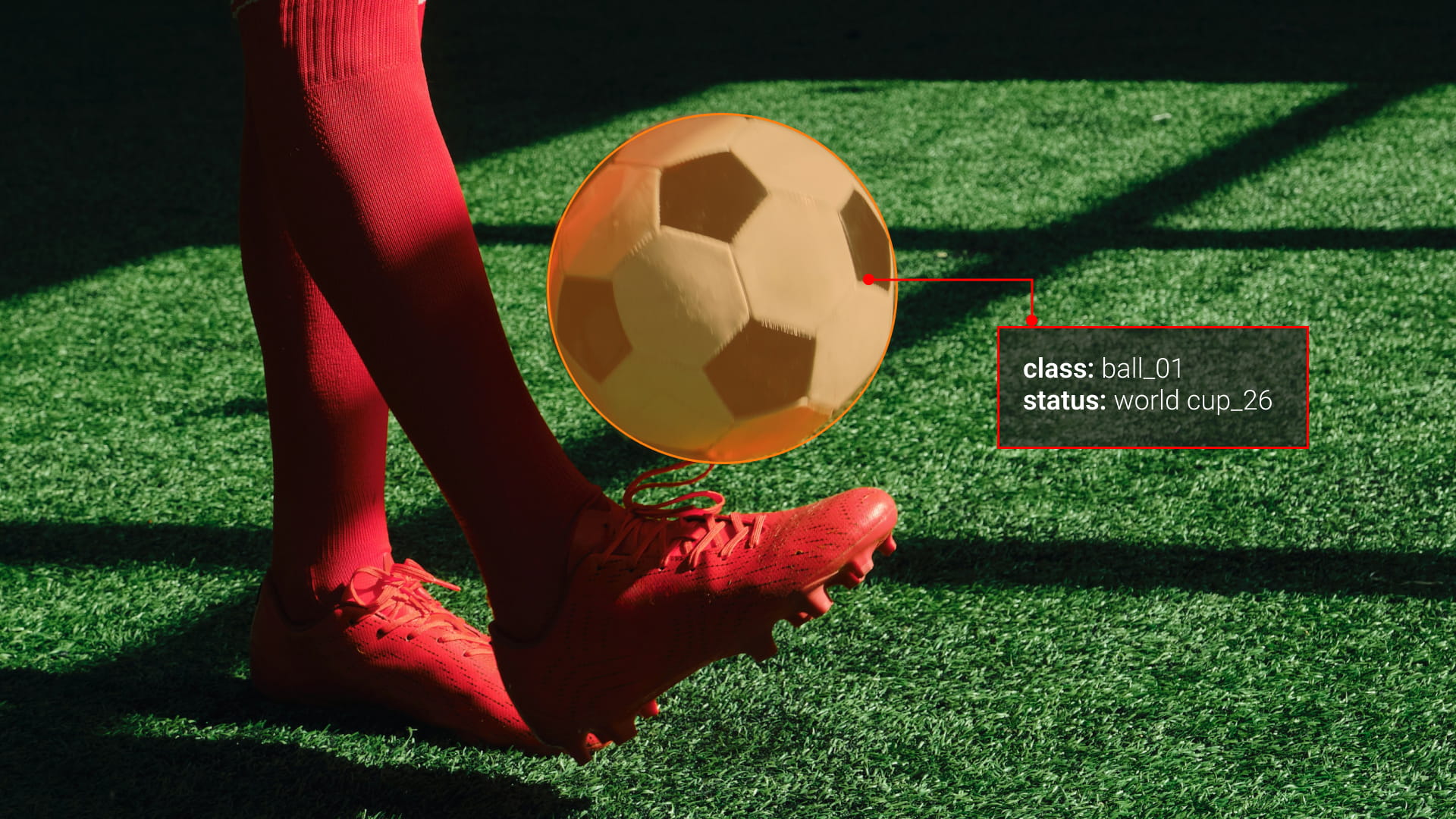
TL;DR
- World Cup 2026 offside tech runs on a multi-sensor fusion stack that estimates each player's body position at the exact moment the ball is kicked, flagging clear offsides within seconds.
- It relies on pose and keypoint estimation, multi-frame tracking, sensor fusion with the 500Hz Trionda ball, and player-specific 3D digital twins built with Gaussian Splatting at sub-centimeter accuracy.
- These are the same computer vision primitives that power pedestrian tracking in autonomous driving, driver monitoring, and retail analytics, and all of them depend on high-quality labeled data.
The 2026 FIFA World Cup is the most heavily instrumented tournament in football history, with cameras, sensors, and computer vision sitting between the play on the pitch and the referee’s final call.
Behind the headline of “AI offside” is a perception stack built on the same techniques that power autonomous vehicles and retail analytics. Here is what that system measures, and what it takes to train it.
The Technical Architecture of World Cup 2026 Offside AI

Advanced Semi-Automated Offside Technology (SAOT) is a multi-sensor fusion system that estimates each player’s body position at the exact moment the ball is kicked, then flags clear positional offsides to officials in seconds.
It is the first time FIFA has sent automated offside alerts directly to on-pitch officials rather than routing everything through the video assistant referee room first.
FIFA confirmed that each of the 16 stadiums runs 16 optical tracking cameras and that the system produces more than 150 million tracking data points per match. The threshold for an automated alert has been tightened to roughly 10 centimeters of clear advantage, down from the 50-centimeter margin used in earlier trials.
Hawk-Eye Innovations supplies the optical tracking layer, and Lenovo provides the underlying infrastructure as FIFA’s official technology partner.
The system is scoped deliberately. It resolves the objective, measurable question of where a player was at the moment of the kick. The judgment of whether an offside-positioned player interfered with play stays with the human referee.
Computer Vision Primitives in the World Cup 2026 Stack
The offside stack runs on pose estimation, multi-camera tracking, sensor fusion, and 3D positional reconstruction. These are the exact primitives that computer vision teams build and label datasets for every day.
Pose and keypoint estimation
The cameras do not simply track where a player stands. They estimate the position of specific anatomical points, which 2026 technical reporting describes as a 29-point digital skeleton covering the head, shoulders, elbows, wrists, hips, knees, ankles, and feet.
This matters because the offside law is judged on the position of the body part that can legally play the ball, not the player’s center of mass. Pose estimation gives the system the limb-level precision that decision requires.
Training a model to find those keypoints reliably depends on annotated data. In this case, only specialized data annotation services can help CV teams label thousands of frames with the correct anatomical landmarks across crowded scenes, partial occlusion, motion blur, and unusual body angles.
The quality of those labels sets the ceiling on how accurate the live system can ever be.
Multi-frame and multi-camera tracking
A single frame is not enough. The system tracks each player continuously across many cameras and many frames, maintaining a consistent identity for every athlete even when they cluster together, cross paths, or briefly disappear behind another body.
Multi-frame object tracking is what lets the system know which limb belongs to which player at the precise frame the ball is struck.
This is a hard data problem. Maintaining identity across occlusion and re-identifying a player after they leave and re-enter a camera’s view are classic failure points, and they are the same challenges that show up in pedestrian tracking for autonomous driving.
Sensor fusion with the connected ball
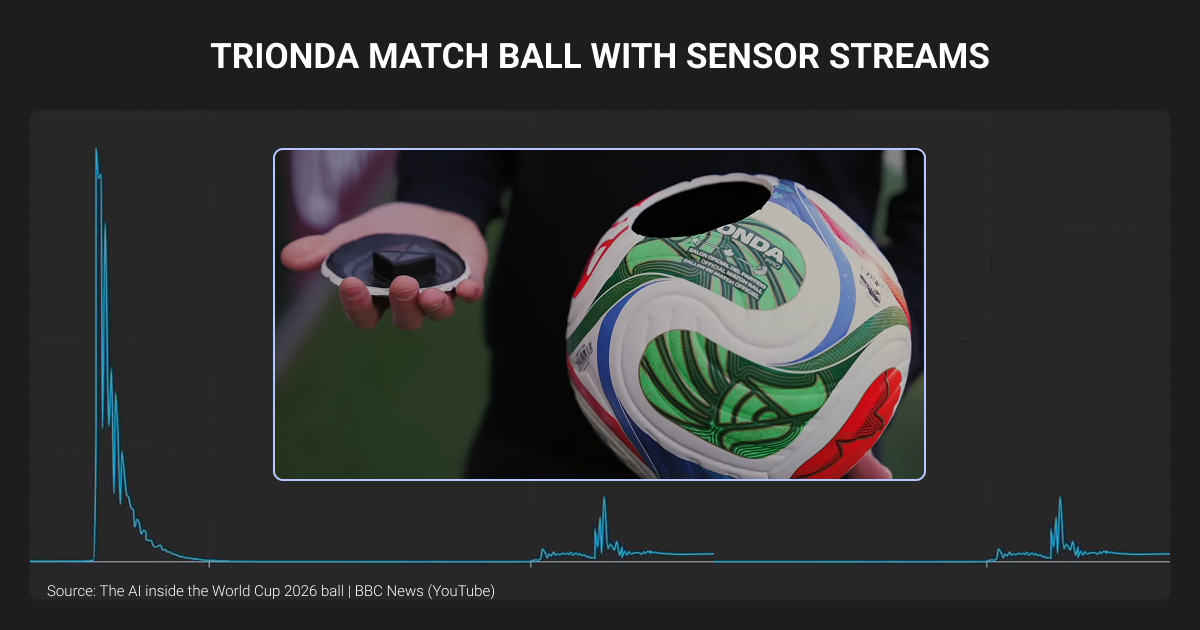
The Adidas Trionda match ball carries a 500Hz inertial measurement unit developed with Kinexon, the firm behind the original connected ball used at Qatar 2022.
The sensor streams motion data to the video assistant referee system in real time, pinpointing the exact millisecond of each touch. During the opening days of the 2026 tournament, officials used that ball-sensor data to resolve a disputed offside call.
Fusing the ball’s kick-moment timing with the camera-derived player geometry is what collapses an offside review from minutes to seconds. Camera data answers where everyone was; the ball answers exactly when.
Aligning those two streams in time is a sensor fusion problem, and getting the fused training data correctly synchronized is its own annotation discipline.
3D Gaussian Splatting for World Cup 2026 Player Twins
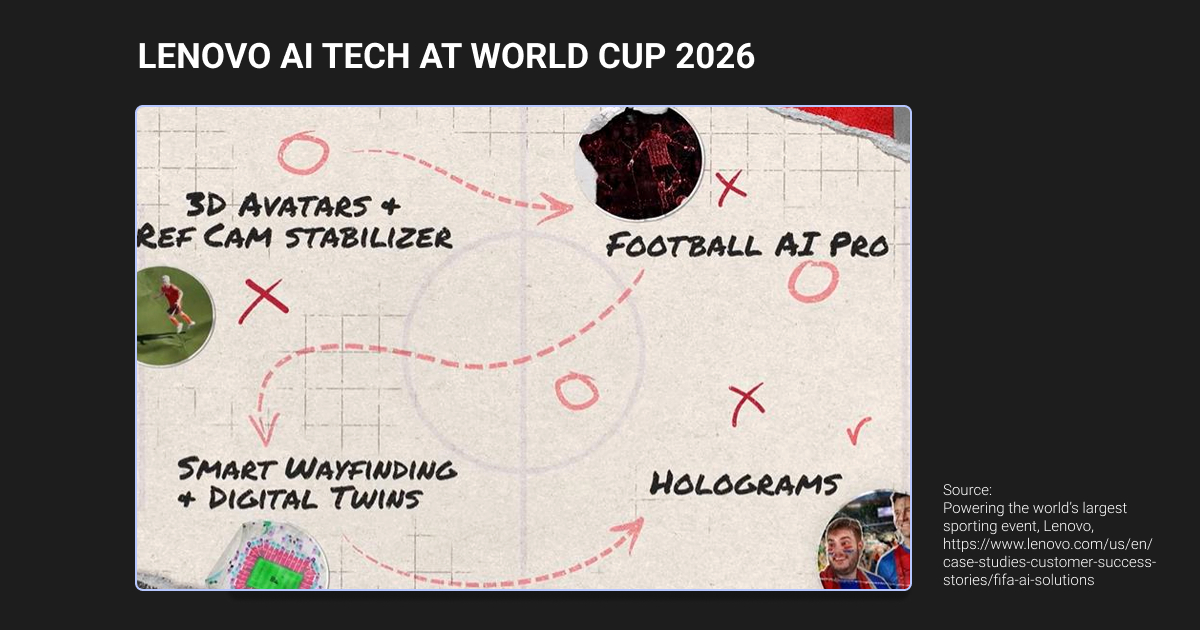
FIFA replaced the generic avatars used in 2022 with player-specific 3D digital twins because no two footballers have the same body geometry, and offside margins are now measured in centimeters.
Every one of the tournament’s 1,248 players was scanned before the tournament to build an individualized model.
The technical detail here is striking. According to a TechRadar at FIFA’s Zurich, the avatars are generated with 3D Gaussian Splatting, a technique in which photographs are converted into clouds of trainable particles whose position, color, and rotation are optimized until they match the real player.
Each player model holds around three million data points at sub-centimeter accuracy, with separate reporting citing 1 to 2 millimeter precision on body shape. A segmentation AI strips clothing from the underlying body geometry so jersey color, squad number, and boots can be changed without rebuilding the model.
Each capture is near-instant, with the actual scan taking around a second inside a ring of cameras. From a modeling perspective, the twin acts as a player-specific geometric prior: the tracking system estimates body state from the cameras, then constrains that estimate with the known anatomy of the actual player.
Personalized priors beat generic ones, and that is true whether the subject is a striker or a pedestrian.
Transferring World Cup 2026 Tech to Commercial Use Cases
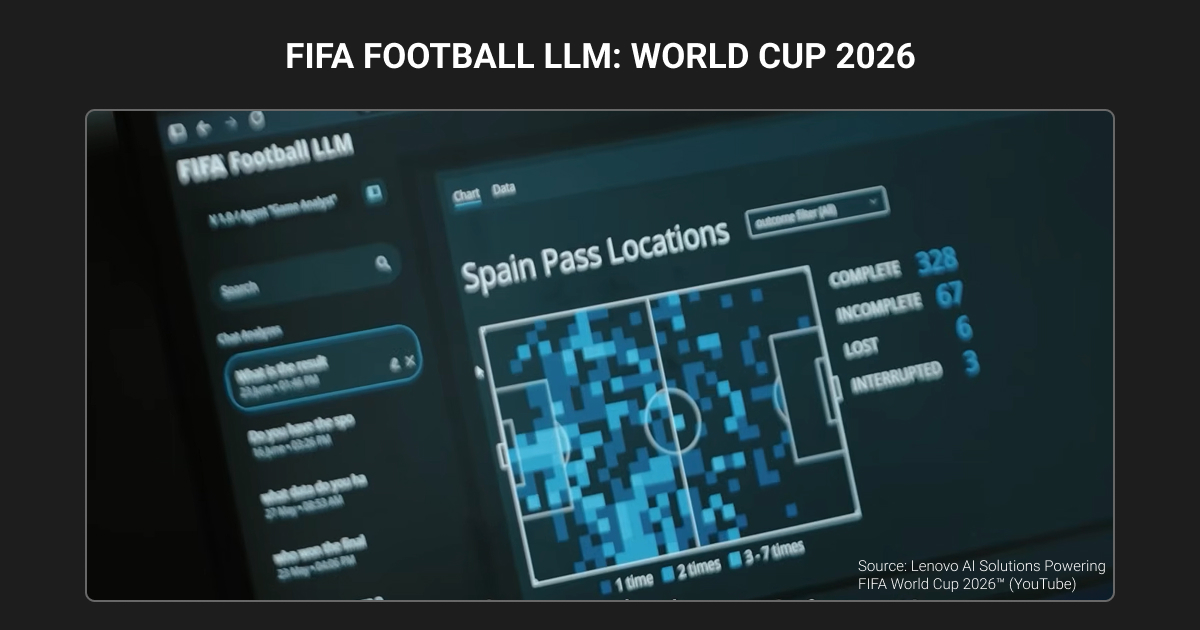
The offside system is a public, high-stakes demonstration of a workflow that computer vision teams run constantly. The same primitives, pose estimation, multi-frame tracking, sensor fusion, and 3D positional annotation, power production systems well outside football.
Consider where these techniques already do critical work:
- Autonomous vehicles and mobility. Pedestrian and cyclist tracking across cameras and LiDAR, plus camera-LiDAR-radar sensor fusion, form the backbone of perception for AV and ADAS programs.
- Driver monitoring. Keypoint and pose estimation track gaze, head position, and posture to detect drowsiness or distraction, the same skeletal-landmark approach used to find a player’s knee.
- Retail and store analytics. Multi-camera shopper tracking with consistent identity across aisles, combined with pose estimation for behavior analysis, mirrors the player-tracking problem almost exactly.
In every one of these cases, the model is only as good as the labeled data underneath it. A keypoint detector trained on sloppy landmarks will misplace a limb.
A tracker trained on inconsistent identity labels will swap two objects under occlusion. A fusion model trained on poorly synchronized streams will misalign time and space. Far from a minor detail, high-quality annotation is the absolute foundation of reliable model performance.
Case Study: Pose Estimation for Motion Gaming Models
The offside use case has a close commercial parallel in interactive entertainment.
Nex, a US motion-gaming company whose camera-based titles translate a player’s real movements into gameplay, hit a familiar wall: limited, low-variety labeled data for its pose estimation model, with large volumes of public footage that were hard to integrate.
Label Your Data delivered two services on an on-demand model. Our team collected publicly available footage for specific target poses and workout movements, then handled skeleton annotation, labeling missing skeletons and validating pre-annotations across nearly 15,000 images with nine dedicated annotators.
The result was a 12% improvement in model accuracy and more consistent body detection, which translated into smoother gameplay for users. The keypoints that track a gamer’s limbs are the same primitive that places a striker’s knee in an offside frame.
Scaling the Training Data Behind World Cup 2026 Precision
The lesson from World Cup 2026 is that frontier perception systems still run on rigorous data annotation.
FIFA’s offside stack reaches centimeter precision because every layer was built on high-quality annotation and human annotation QA before a single live decision was made. The keypoints, the player tracks, the fused ball timing, and the 3D geometry all started as labeled data.
Label Your Data is an AI data partner specializing in exactly these computer vision techniques: keypoint and pose annotation, multi-frame object tracking, 3D point cloud and sensor fusion labeling, and segmentation, with a human-led quality assurance process behind every dataset.
If your team is building perception systems that depend on getting limb-level position, object identity, or fused sensor timing right, the data behind those models deserves the same rigor FIFA put behind the offside call.
About Label Your Data
If you choose to delegate computer vision annotation for production-grade perception systems, run a free data pilot with Label Your Data. Our outsourcing strategy has helped many companies scale their ML projects. Here’s why:
 Data Annotation for Complex Environments
Rely on consistent, high-quality output for complex datasets, detailed taxonomies, and edge cases.
 Structured Quality From Pilot to Production
Get quality engineered into every step through onboarding, evolving guidelines, QA, and continuous feedback.
 Flexible and Scalable Operations
Adjust team capacity, project size, and delivery model as you scale, with no setup fees or long-term lock-ins.
 An Integrated Delivery Partner
Align on goals, workflows, and expectations with a team that integrates into your process from day one.
 Projects Led by Annotation Experts
Work with former annotators who understand annotation complexity, quality standards, and high-volume delivery.
Written by
CEO of Label Your Data
Karyna is the CEO of Label Your Data, a company specializing in data labeling solutions for machine learning projects. With a strong background in machine learning, she frequently collaborates with editors to share her expertise through articles, whitepapers, and presentations.