


 Back to blog
Label Your Data vs Kili Technology: Which Labeling Approach Fits Your ML Workflow?

 CEO of Label Your Data


Table of Contents

- TL;DR
- The Annotation Vendor Decision ML Teams Get Wrong
- Label Your Data vs Kili Technology: Service-First vs Platform-First Models
- Platform Capabilities: Label Your Data vs Kili Technology
- Data Annotation Pricing, Compliance, and Operational Realities
- Making the Vendor Decision: Label Your Data or Kili Technology?
- About Label Your Data
-
FAQ
- Can Label Your Data integrate with our existing ML pipeline without switching platforms?
- Which vendor is better for autonomous vehicle projects requiring LiDAR annotation?
- What’s the actual cost difference between Label Your Data and Kili Technology?
- Do I need in-house annotation expertise to use either annotation solution?
- Can either vendor handle our compliance requirements?

TL;DR
- Label Your Data provides managed annotation services handling your workforce. Kili Technology provides platform infrastructure for teams managing their own annotators.
- Label Your Data specializes in 3D/LiDAR with sensor fusion. Kili excels at PDF/document annotation and LLM fine-tuning workflows.
- Tool-agnostic flexibility preserves existing ML infrastructure. Deep SDK integration optimizes standardized framework workflows.
The Annotation Vendor Decision ML Teams Get Wrong
Your machine learning algorithm accuracy plateaus. Your team burns the budget on data annotation that doesn’t improve performance. You’re evaluating vendors, but feature lists don’t tell you which operating model actually fits your workflow.
The mistake most ML teams make: choosing annotation vendors based on capabilities rather than operational fit. One vendor operates as a managed service that handles your annotation workforce. The other provides platform infrastructure for teams building their own annotation operations.
Both serve enterprise clients with strong compliance, but they solve fundamentally different problems.
This comparison examines Label Your Data vs Kili Technology across service delivery, platform capabilities, automation, quality control, integration, and pricing to help you determine which approach matches your machine learning workflow.
Label Your Data vs Kili Technology: Service-First vs Platform-First Models
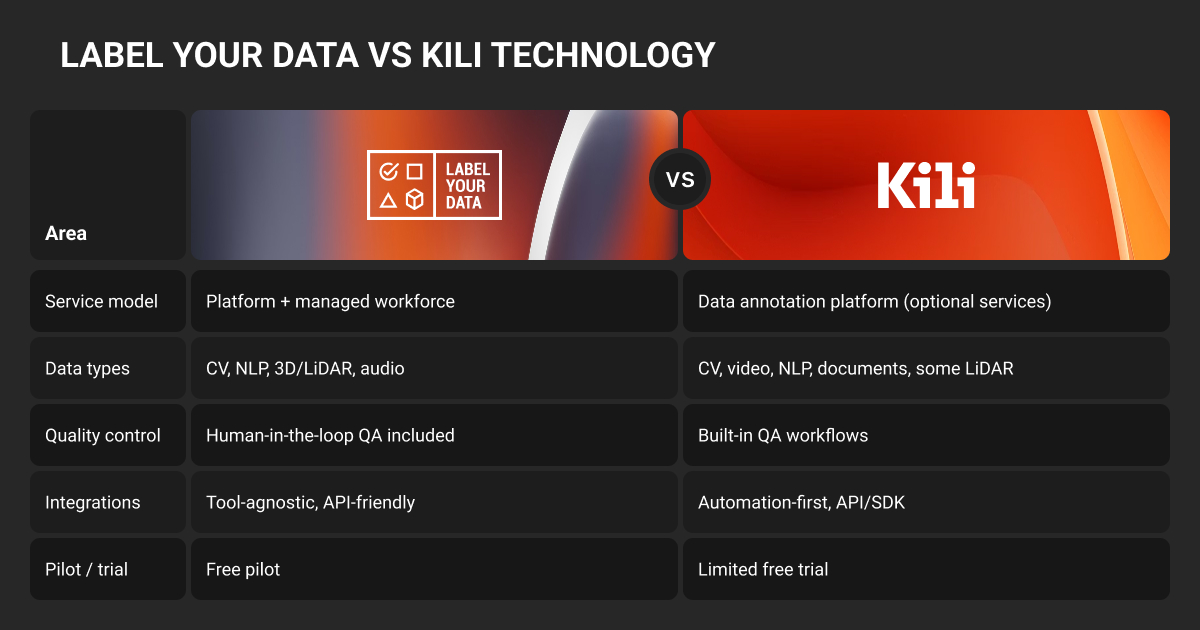
Label Your Data — managed annotation with platform solution
Label Your Data is the industry-leading data annotation services provider. Founded in 2020, the company maintains 1,000+ trained annotation experts across 25 countries supporting 55 languages.
The vendor emphasizes human expertise:
- Clients describe requirements and receive dedicated account managers
- Labeled data delivered on regular schedules
- Data annotation platform primarily for computer vision self-serve
- NLP, audio, and complex annotation handled through managed services
This is tool-agnostic outsourcing. Label Your Data works within your existing infrastructure rather than forcing you to commit to their platform.
Kili Technology — platform for teams managing their own workforce
Kili Technology takes the opposite approach. Platform-first company with optional managed services. Founded in 2018, they built comprehensive labeling infrastructure for data science teams wanting direct control.
The platform supports:
- Teams scaling from individual contributors to 1,000+ annotators
- Project management dashboards and workforce analytics
- Self-serve operations with deep technical integration
- Managed annotation as add-on
This is infrastructure for teams who want control over their annotation operations and plan to build internal capability.
The architectural difference shapes everything else. Teams without annotation infrastructure get operational complexity handled by Label Your Data. Teams building annotation capability get superior tooling and control from Kili.
Platform Capabilities: Label Your Data vs Kili Technology
Data type coverage
Label Your Data’s strength: 3D and spatial data
Competitive advantage in point cloud, aka LiDAR annotation:
- PCD formats with JSON calibration files
- Sensor fusion combining LiDAR with RGB camera data
- Multi-frame sequential annotation for autonomous systems
Computer vision tasks: bounding boxes, polygons, polylines, keypoints, semantic segmentation, instance segmentation, panoptic segmentation, image recognition, 3D point clouds and cuboids.
Video versatility: frame-by-frame annotation with multiple types (not just bounding boxes).
Kili Technology’s strength: Document intelligence and LLM workflows
Platform optimized for text and document processing:
- Native PDF annotation (multipage documents, invoices, contracts)
- Named entity recognition and entity relation extraction
- LLM fine tuning: RLHF ranking tasks, supervised fine-tuning for dialogue systems
- Geospatial tools with EPSG coordinate reference systems
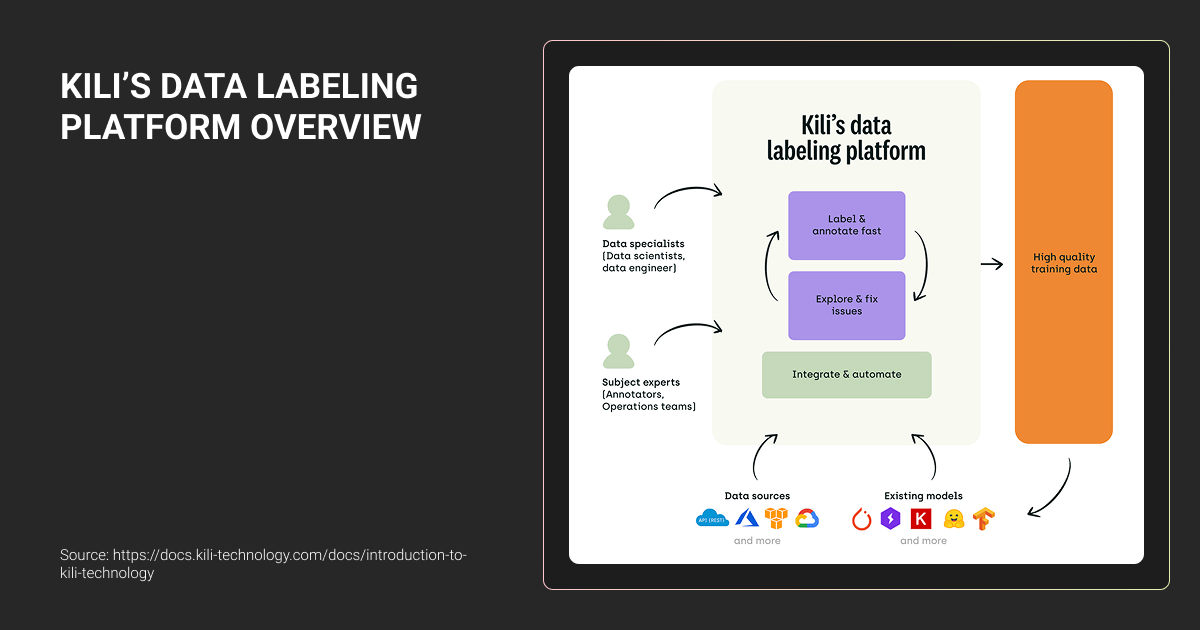
Notable limitation: video annotation currently supports bounding boxes only. Teams needing polygon tracking or segmentation on video hit platform constraints.
Data type capabilities compared
| Data Type | Label Your Data | Kili Technology |
| Images | Full support | Full support |
| Video | Frame-by-frame, all annotation types | Bounding boxes only |
| Text/NLP | Via managed services | Native platform |
| PDF documents | Via managed services | Native multipage |
| 3D point cloud/LiDAR | Comprehensive (sensor fusion) | Not documented |
| Geospatial | Strong evidence | Specialized tooling |
Automation and ML assistance
Kili’s platform-native automation
Built-in ML features for annotation efficiency:
- Foundation models: SAM, SAM 2, ChatGPT for pre-annotation (claims 10x faster)
- Active learning: uncertainty-based prioritization focuses effort on high-impact data
- LLM co-pilot: one-click pre-annotation for text
- Model-in-the-loop workflows integrated into platform
Label Your Data’s tool-agnostic approach
Automated annotation through flexibility, not built-in features:
- API access for programmatic workflows
- Works with CVAT, Label Studio, custom data annotation tools
- Customizable exports for any ML framework
- Less platform automation, but more freedom to use existing ML-assisted approaches
Teams with existing ML tooling preserve investments with the tool-agnostic approach. Teams building from scratch get faster paths with platform automation.
Data annotation quality
Label Your Data: relationship-driven QA
Three-tier pipeline with human oversight:
- Annotator self-review, peer review, expert validation
- 98%+ accuracy benchmark
- Cross-reference consensus for subjective tasks
- Milestone checkpoints for large machine learning datasets
- Account managers surface issues through communication, not just dashboards
Kili Technology: metrics-driven quality tools
Programmatic quality monitoring:
- Consensus scoring (inter-annotator agreement measurement)
- Honeypot testing against golden standards
- Automated error detection
- Workforce performance dashboards
- 95%+ accuracy guarantee
Both approaches deliver. The question is whether you prefer human project management or programmatic monitoring.
Technical integration approaches compared
Kili’s deep technical integration
Platform designed for ML workflow embedding:
- Open-source Python SDK (GitHub/PyPI)
- GraphQL API for flexible querying
- Native exports: YOLO V4/V5/V7/V8, PASCAL VOC, COCO, TensorFlow Record
- Cloud storage: AWS S3, GCS, Azure (data stays in your infrastructure)
- Webhooks for training automation
- Deployment: on-premise, customer cloud, or managed
Label Your Data’s platform-agnostic integration
Label Your Data integrates with your existing annotation tools rather than requiring platform adoption:
- REST API for upload/download automation
- Customizable exports adaptable to any framework
- Compatible with CVAT, Label Studio, custom interfaces
- Trade-off: no SDK or pre-built integrations, but no platform lock-in
Teams standardized on specific frameworks get smoother data flow with Kili’s SDK. Teams using varied tooling get more freedom with Label Your Data’s tool-agnostic approach to high-quality data annotation.

When labeling guidelines get complicated, Label Your Data delivers better accuracy. For high-volume work where accuracy is critical, a managed service like Label Your Data is worth it.

 Founder and CEO, Superpencil (Enlighten Animation Labs)
Data Annotation Pricing, Compliance, and Operational Realities
Label Your Data: transparent per-unit pricing
Published rates (no quotes required):
- $0.02 per bounding box
- $0.015 per keypoint
- $0.02 per NLP entity
- $6 per annotator hour (complex work)
- No minimum orders
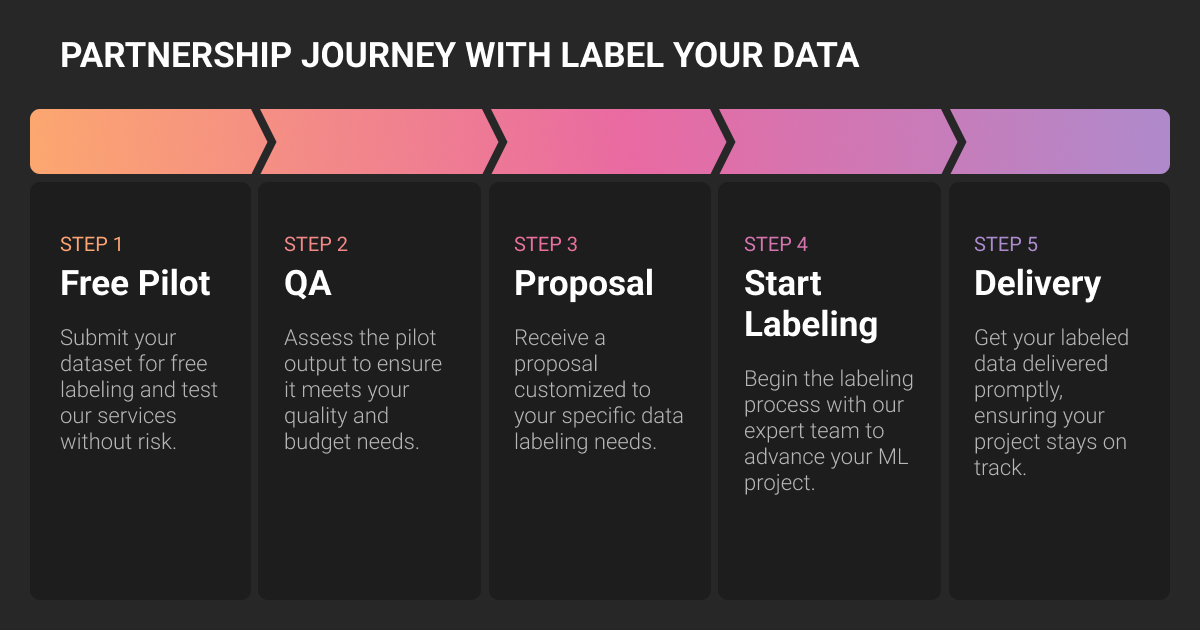
- Free pilot project
- $100 minimum platform balance after pilot
- Typical projects: $3,000–$10,000+
Use our data annotation pricing calculator to estimate costs instantly. Select your application field (computer vision, NLP, or other), choose annotation method, specify volume, and get real-time pricing before commitment.
Kili Technology: tiered platform model
Tiered pricing structure:
- Free tier: 5,000 annotations, 5 collaborators, 500MB storage
- Paid tiers: usage-based (requires quotes)
- Managed services: $6–$60/hour add-on
- 20% discount on annual billing
| Aspect | Label Your Data | Kili Technology |
| Free option | Pilot project | 5k labels, 5 collaborators |
| Entry cost | $0.02/bbox, $6/hour | Quote-based |
| Minimums | None | None (free tier) |
| Budget predictability | High | Medium |
Teams needing budget approval simplify planning with Label Your Data’s cost calculator and free pilot with no forced commitment. Those wanting extended platform testing can evaluate Kili’s free tier (5,000 annotations).
Compliance credentials and security
Both maintain enterprise-grade compliance for regulated industries.
Certifications:
- Label Your Data: PCI DSS Level 1, ISO 27001:2013, GDPR/CCPA/HIPAA
- Kili Technology: SOC 2 Type II, ISO 27001:2013, HIPAA
Security approaches:
- Label Your Data: background checks, NDAs, secure workspaces, video surveillance, in-house servers
- Kili Technology: validated by defense contractors (Thales, Safran), on-premise deployment options
Label Your Data’s PCI DSS Level 1 particularly suits payment processing. Both handle healthcare, defense, financial services.
The key difference comes down to control versus speed. Kili shines when you want full ownership of the workflow. Label Your Data is ideal when speed, security, and simplicity matter most — you hand off the workload and get high-quality annotations back quickly.
 Co-founder&CEO, Aitherapy
Client work and proven use cases
Label Your Data serves academic institutions (Yale, Princeton, KAUST, George Washington University, Technological University Dublin) and enterprise clients across vision AI (Nexvision for defense/aerospace embedded systems), AI safety (Guardrails AI for LLM compliance filters), autonomous vehicles (Nodar for 3D perception), and AI-powered software (Skylum photo editing).
Additional case studies include military drone navigation and NATO-compliant defense annotation.
Kili Technology focuses primarily on European enterprises: financial services (LCL Bank, Crédit Agricole), manufacturing (Airbus, Renault, Stellantis), luxury retail (Louis Vuitton), and insurance (Groupe Covéa). Their case studies show regulatory compliance processing and high-volume document analysis.
Both vendors handle complex, regulated projects. Label Your Data serves sectors from research to enterprise with diverse computer vision, NLP, and AI safety needs. Kili concentrates on platform deployments for large organizations with document-heavy workflows.
Making the Vendor Decision: Label Your Data or Kili Technology?
Where each vendor genuinely excels
Label Your Data’s core strengths:
- Turnkey managed services (no infrastructure required)
- Tool-agnostic flexibility (preserves existing investments)
- 3D point cloud/LiDAR specialization
- No minimum orders (accessible entry)
- Video annotation beyond bounding boxes
- Published transparent pricing
- 24/7 availability including weekends
- Dedicated account management
Kili Technology’s core strengths:
- ML automation (SAM, active learning, LLM co-pilots)
- Deep technical integration (SDK, GraphQL, native exports)
- Self-serve scalability (1–1,000+ annotators)
- Native PDF/document annotation
- LLM fine-tuning workflows
- Free tier for evaluation
- Workforce analytics dashboards
- Platform for building annotation capability
For deeper analysis of Kili Technology’s capabilities, read our Kili Technology company review. We’ve also compared Kili against other vendors in Kili Technology vs. iMerit and Kili Technology vs. CloudFactory in-depth guides.
Pick your operating model
The vendor choice hinges on the operational model. Outsourcing annotation work? Label Your Data provides managed services with tool-agnostic flexibility and transparent pricing. Building internal capability? Kili Technology provides platform infrastructure with ML automation and deep integration.
Both maintain enterprise compliance and quality delivery (Label Your Data: 4.9/5 on G2, 5.0/5 on Clutch; Kili: 4.7/5 on G2).
| Decision Factor | Choose Label Your Data | Choose Kili Technology |
| Operating model | Outsource annotation operations | Build internal annotation capability |
| Tooling approach | Tool-agnostic (CVAT, Label Studio, custom) | Platform-centric (SDK, native integration) |
| Data specialization | 3D/LiDAR, spatial data, diverse video annotation | Documents, PDFs, LLM fine-tuning |
| Pricing model | Published per-unit rates, no minimums | Tiered platform, free tier for testing |
| Automation | Use your existing ML tools | Built-in (SAM, active learning, pre-labeling) |
| Management style | Human QA experts and account managers | Self-serve dashboards, workforce analytics |
| Best for projects | Enterprise, research, specialized applications (defense, autonomous systems, AI safety) | Large-scale enterprise, high-volume document processing |
You’ve likely experienced the frustration of choosing vendors based on feature lists only to discover operational misalignment months later. This comparison cuts through that: Label Your Data operates as a managed service provider with tool-agnostic flexibility. Kili Technology operates as an annotation platform for teams building internal capability.
The decision comes down to where annotation sits in your workflow. If you’re building annotation operations as core capability, platform infrastructure provides the control you need. If you’re outsourcing to focus on model development, managed services deliver without forcing infrastructure changes while preserving your existing ML tooling.
About Label Your Data
If you choose managed annotation services, run a free data pilot with Label Your Data. Our outsourcing strategy has helped many companies scale their ML projects. Here’s why:
 Data Annotation for Complex Environments
Rely on consistent, high-quality output for complex datasets, detailed taxonomies, and edge cases.
 Structured Quality From Pilot to Production
Get quality engineered into every step through onboarding, evolving guidelines, QA, and continuous feedback.
 Flexible and Scalable Operations
Adjust team capacity, project size, and delivery model as you scale, with no setup fees or long-term lock-ins.
 An Integrated Delivery Partner
Align on goals, workflows, and expectations with a team that integrates into your process from day one.
 Projects Led by Annotation Experts
Work with former annotators who understand annotation complexity, quality standards, and high-volume delivery.
FAQ
Can Label Your Data integrate with our existing ML pipeline without switching platforms?
Yes. Label Your Data works tool-agnostically with CVAT, Label Studio, or custom annotation interfaces. No platform migration required. You get managed annotation services while preserving your ML infrastructure investments. Kili requires adopting their platform architecture.
Which vendor is better for autonomous vehicle projects requiring LiDAR annotation?
Label Your Data specializes in 3D point cloud and LiDAR annotation with sensor fusion capabilities (combining LiDAR with RGB camera data). Their case studies include military drones and autonomous vehicles. Kili Technology doesn’t explicitly document LiDAR capabilities, and their video annotation is limited to bounding boxes only.
What’s the actual cost difference between Label Your Data and Kili Technology?
Label Your Data has transparent per-unit pricing: $0.02/bounding box, $0.015/keypoint, $6/hour for complex work. No minimums. Free pilot project to test service quality before committing.
Kili’s paid tiers require quotes but offer a free tier (5,000 annotations) for evaluation. For budget predictability and smaller projects, Label Your Data’s pricing plus free pilot simplifies planning and procurement.
Do I need in-house annotation expertise to use either annotation solution?
No for Label Your Data because they handle recruiting, training, managing, and QA through dedicated annotation experts and account managers. Yes for Kili Technology: their platform assumes you’re managing your own annotation workforce (1-1,000+ annotators). Choose based on whether you’re building internal annotation capability or outsourcing it.
Can either vendor handle our compliance requirements?
Both maintain enterprise-grade compliance. Label Your Data is data-compliant: PCI DSS Level 1, ISO 27001, GDPR/CCPA/HIPAA. Kili Technology: SOC 2 Type II, ISO 27001, HIPAA. Label Your Data’s PCI DSS Level 1 particularly suits payment processing. Both serve defense, healthcare, and financial services clients.
Written by
CEO of Label Your Data
Karyna is the CEO of Label Your Data, a company specializing in data labeling solutions for machine learning projects. With a strong background in machine learning, she frequently collaborates with editors to share her expertise through articles, whitepapers, and presentations.